
Bergama and the Acropolis of Pergamon
Bergama in İzmir Province is the modern town beneath ancient Pergamon, where a hilltop acropolis, a healing sanctuary and a Roman basilica reveal centuries of Anatolian history.
Bergama is a town in İzmir Province on the western side of Türkiye, set in the broad Bakırçay plain between olive groves and low surrounding hills. Above it rises a steep rocky height crowned by the ruins of Pergamon, one of the notable cities of the ancient Greek and Roman world. The modern town and the ancient acropolis share the same landscape, which is why the area is often described as a layered cultural landscape — a place where centuries of settlement sit almost directly on top of one another.
A City on a Steep Hill
The Acropolis of Pergamon occupies a dramatic position, roughly 300 metres above the plain. Reaching the summit reveals the scale of the ancient city's planning: terraces cut into the slope, stone stairways, and foundations that follow the contours of the rock. The site forms part of the UNESCO World Heritage listing known as Pergamon and its Multi-Layered Cultural Landscape, and it has been excavated and studied for well over a century.
Among the structures on the upper acropolis are the Temple of Trajan, the Temple of Athena, remains of the royal palaces, the upper and lower agoras, and the large theatre. The theatre is built into the hillside itself, with rows of seats arranged on the steep slope and a wide view over the valley below.
The Library and the City of Learning
Pergamon was known as a centre of learning, and its library was among the largest of the ancient world. According to tradition, rivalry with the library of Alexandria encouraged the wider use of parchment as a writing material, and the word itself is linked to the city's name. Statues, inscriptions and architectural fragments from the acropolis are displayed in the Bergama Museum in the town below, together with finds from nearby sites.
The Sanctuary of Asklepios
Below the acropolis, on the other side of the modern town, lies the Asklepion, a sanctuary dedicated to Asklepios, the god of healing. It worked as a healing centre as well as a religious site, and its layout includes a colonnaded sacred street, a circular treatment building, a small theatre and a spring. Visitors walk between column stumps and stone walls in a quiet, tree-lined setting that feels quite different from the exposed heights of the acropolis.
The Red Basilica and the Lower Town
Near the centre of Bergama stands the Red Basilica, a tall structure of reddish brick built in the Roman period and later used as a church. Its massive walls still dominate the surrounding streets. The lower town also holds remains of a Roman theatre, an amphitheatre and stretches of ancient road, showing how far the city spread beyond the hill.
Landscape, Textiles and Local Life
The countryside around Bergama is agricultural, with cotton, olives and vineyards across the plain. The town has a long tradition of weaving; Bergama carpets and kilims are known for their geometric patterns and warm colours, and the craft remains part of local identity. Markets in the town centre reflect this rural setting, with produce, cheese and other regional foods brought in from surrounding villages. Spring brings green hillsides and wildflowers, while autumn offers mild weather for walking the archaeological areas. Early morning and late afternoon light are especially striking on the acropolis.
Exploring the Site Thoughtfully
Bergama can be explored on foot, though the climb to the acropolis is steep and the stone surfaces can be uneven. The ancient site and the Asklepion are separate locations, and both reward time rather than a quick pass. Because the ruins are largely open to the sky, it helps to plan around the heat of midday. Together, the hilltop city and the healing sanctuary tell a long story of architecture, science and daily life in western Anatolia, and they continue to shape how Bergama is understood today.
Related content
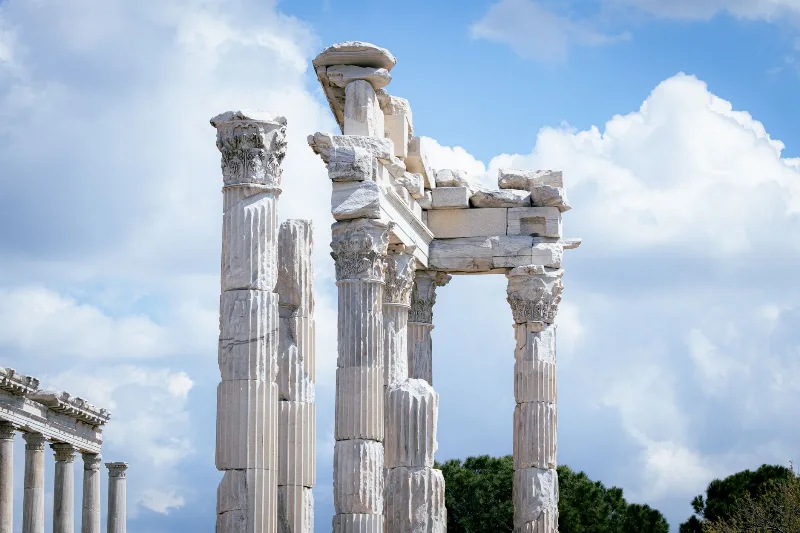
Bergama
Bergama is an inland district of İzmir Province on the Bakırçay plain, built around the ancient city of Pergamon, a UNESCO World Heritage Site reached by a cable car up to its acropolis.
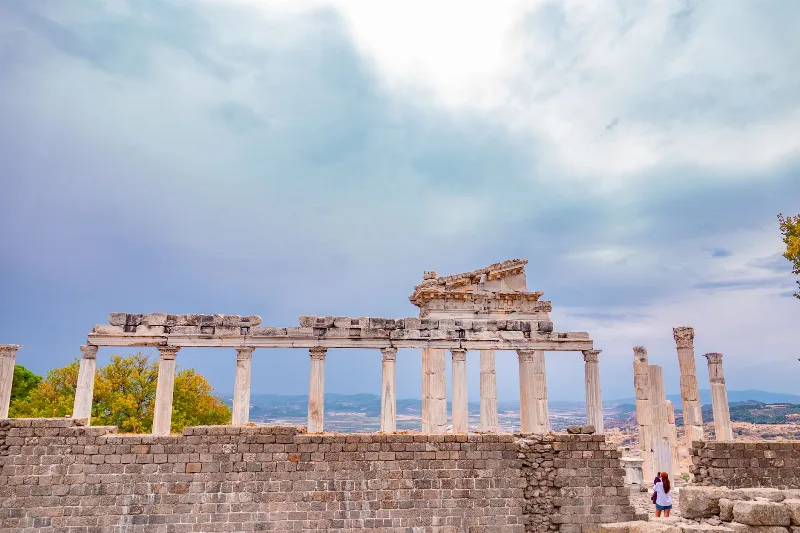
Pergamon
Pergamon was the Hellenistic capital of the Attalid dynasty in western Türkiye, built around a steep acropolis above the modern town of Bergama. Its Great Altar, theatre and Sanctuary of Asclepius make it one of the most important archaeological sites in Anatolia and a UNESCO World Heritage Site.
Pergamon
Pergamon is an ancient Greek city in Aeolis, today the modern town of Bergama in İzmir Province, Türkiye. Its acropolis, library and Great Altar of Zeus, together with the Asclepion healing sanctuary, form one of the most important archaeological settings in the eastern Mediterranean.
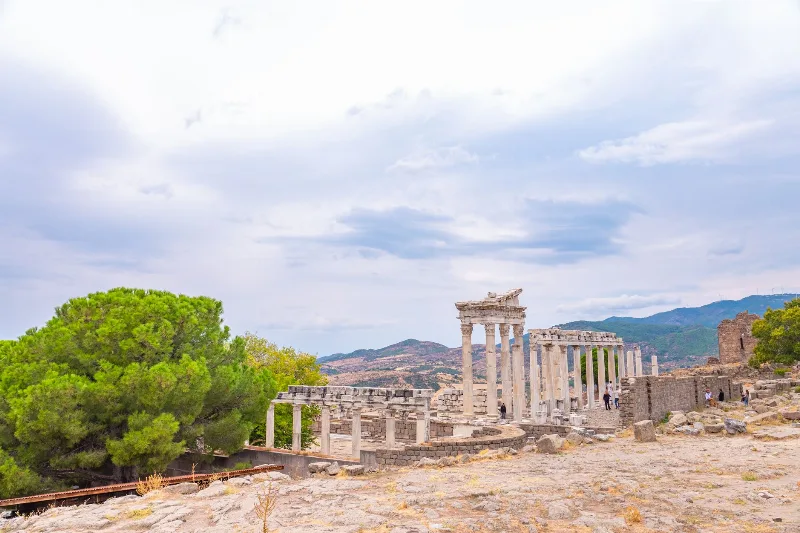
The Ancient City of Pergamon and Its Acropolis
Pergamon, now Bergama in Türkiye, is a UNESCO World Heritage Site with a dramatic acropolis, a Hellenistic theater, and a library that once rivaled Alexandria. Its ruins offer a deep dive into ancient history and culture.
2-Day Bergama and Ayvalık Route: Pergamon to Cunda Island
A compact two-day route that pairs the terraced ruins of ancient Pergamon in inland Bergama with the olive-growing Aegean coast at Ayvalık and the causeway-linked island of Cunda.
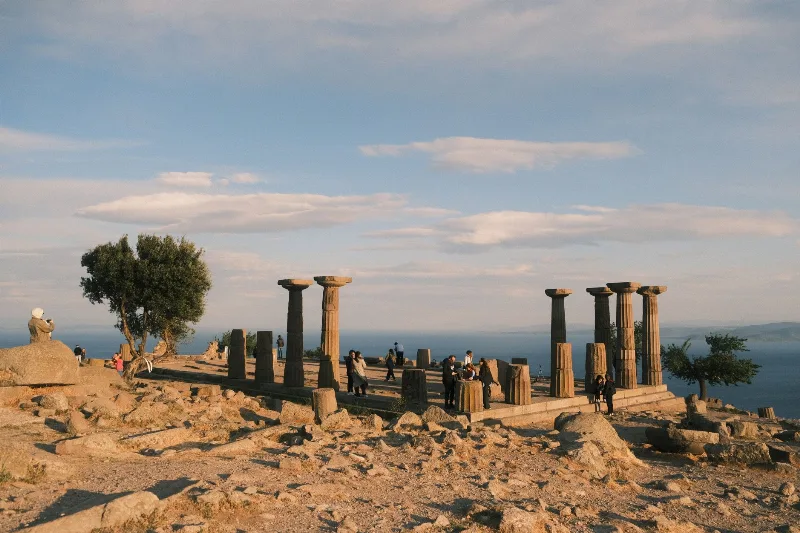
4-Day North Aegean Coast Route
A four-day linear route along the North Aegean coast from Assos to İzmir, with stops at Ayvalık, Cunda, Dikili, Çandarlı, Bergama and Foça. The itinerary is designed for a realistic coastal and inland road trip by car.
7-Day North Aegean to Ephesus Route
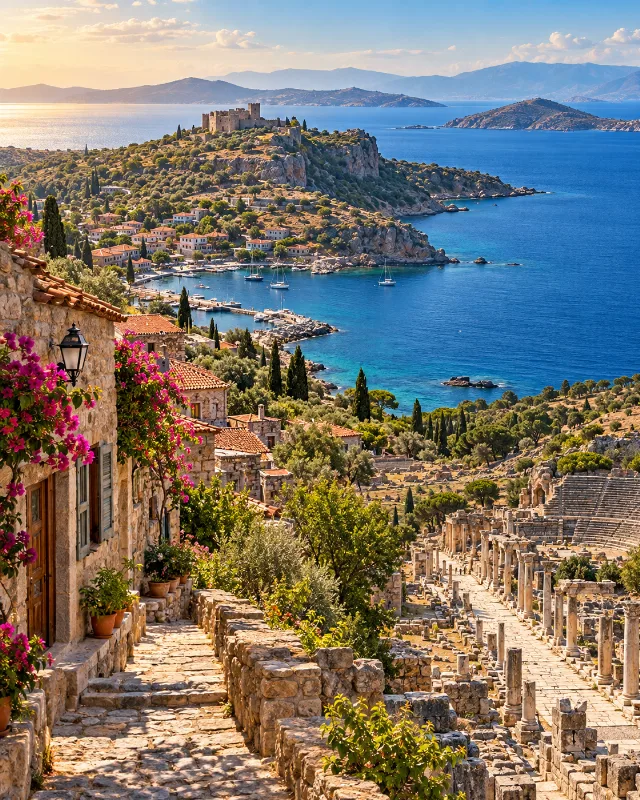
A seven-day southbound route through Troy, Assos, Bozcaada, Ayvalık, Bergama, İzmir and Ephesus, combining archaeology, coastal towns and Aegean culture.
Izmir's Coastal Charm
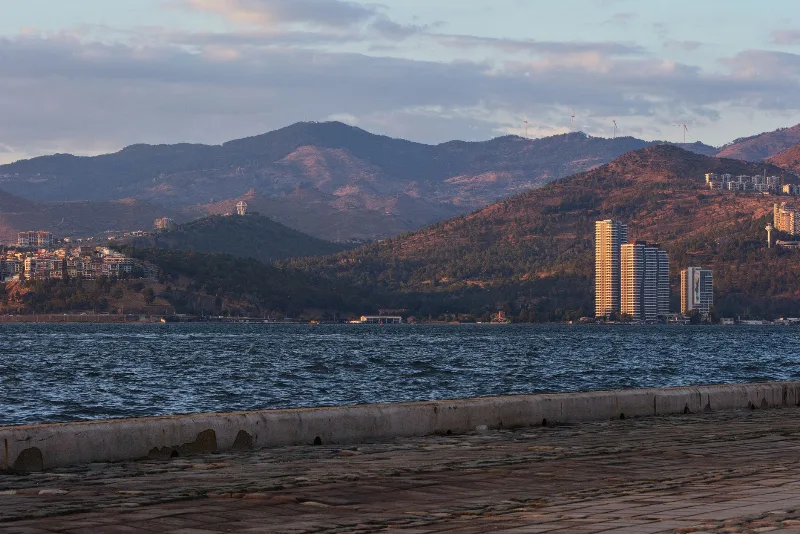
İzmir is a western Turkish city built around a gulf of the Aegean Sea, where a long waterfront, nearby coves, ancient sites and Aegean cooking shape its coastal character.