
Pergamon
Pergamon was the Hellenistic capital of the Attalid dynasty in western Türkiye, built around a steep acropolis above the modern town of Bergama. Its Great Altar, theatre and Sanctuary of Asclepius make it one of the most important archaeological sites in Anatolia and a UNESCO World Heritage Site.
Pergamon was an ancient Greek city in İzmir Province, western Türkiye, built on and around a steep hill that rises above the modern town of Bergama and the Bakırçay plain. It is best known as the capital of the Attalid dynasty in the Hellenistic period, when it ranked among the most important political and cultural centres of the Greek world. Its monumental acropolis, the Great Altar and the Sanctuary of Asclepius are among the most significant archaeological remains in Anatolia, and the site was inscribed on the UNESCO World Heritage List in 2014.
Where Pergamon Lies
Pergamon occupies a steep, terraced hill together with the slopes and plain around it, in the district of Bergama in İzmir Province. The hill commands the broad Bakırçay plain, which corresponds to the plain of the ancient Caicus River, and the ancient city controlled an important route between the Aegean coast and the interior of western Anatolia. Modern Bergama, a town with Ottoman and later layers, sits at the foot of the acropolis hill, and the site lies roughly 100 kilometres north of İzmir.
Pergamon was never itself a coastal settlement. Its strength came from a defensible acropolis, a fertile hinterland and access to the sea through its harbour, Elaia, at the mouth of the Caicus. This combination of a protected high point and productive land helped the city grow from a small stronghold into a regional power.
From Fortress to Royal Capital
After the death of Alexander the Great in 323 BC, control of Anatolia passed among his successors. Pergamon first appears as a fortified stronghold held on behalf of Lysimachus of Thrace. Around 281 BC Philetaerus, the officer entrusted with the fortress, took control of it and founded the dynasty known as the Attalids. His successors — Eumenes I, Attalus I, Eumenes II, Attalus II and Attalus III — ruled for more than a century and gradually transformed the stronghold into a planned royal capital.
Attalus I won a celebrated victory over the Galatians, groups of Celtic peoples who had entered Anatolia, and commemorated it in sculpture and dedications. Under Eumenes II the city reached its architectural peak: the acropolis was terraced, the Great Altar and a large library were built, and Pergamon's reputation as a centre of learning and art grew. In 133 BC Attalus III died and left his kingdom to Rome; Pergamon then became the capital of the Roman province of Asia.
The Acropolis and the Upper City
The acropolis of Pergamon is a striking example of Hellenistic urban planning, with buildings arranged on artificial terraces cut into a very steep slope. The upper city contained royal palaces, the Great Altar, the Sanctuary of Athena, the Temple of Dionysus, the library, the Upper Agora, the theatre and the later Roman Temple of Trajan. Because of the gradient, construction demanded large retaining walls and carefully engineered platforms, and the remains of these structures still define the shape of the hill. Lower down the slope lay the extensive gymnasium complex and residential quarters, while sanctuaries such as that of Demeter occupied the middle slopes.
The Great Altar of Zeus
The Great Altar was built in the first half of the second century BC, most probably under Eumenes II. Its most famous feature is a long sculpted frieze showing the Gigantomachy, the mythical battle between the gods and the giants, which decorated the base of the altar and ran for roughly 120 metres. A second, smaller frieze depicted scenes from the life of Telephus, the legendary founder associated with the city's royal line.
The altar was excavated in the late nineteenth century by German archaeologists, and its sculpted frieze was taken to Berlin, where it is displayed in the Pergamon Museum. On the acropolis itself, the altar's foundations and terrace can still be seen, although the sculpted reliefs are no longer in place.
Sanctuaries, Temples and the Trajaneum
Among the earliest major buildings on the acropolis was the Temple of Athena Polias, built in the Doric order and long a focus of civic cult. The Sanctuary of Demeter stood on the southern slope, and the Temple of Dionysus occupied its own terrace on the hillside. The highest terrace of the acropolis was later given over to the Trajaneum, a Roman temple dedicated to the emperor Trajan and to Zeus, completed under Hadrian. These structures show how the religious landscape of Pergamon changed from Hellenistic royal patronage to Roman imperial worship.
The Library and the Story of Parchment
The library of Pergamon was regarded in antiquity as second only to the library of Alexandria, and it attracted scholars to the city. Traditional estimates of its holdings are uncertain and should be treated with caution, but its fame was genuine. Pergamon is also linked to the development of parchment, the writing material made from prepared animal skins.
Ancient sources report a tradition that, when the Ptolemies of Egypt restricted the export of papyrus, the scholars of Pergamon turned to treated skins, and from this association the material received the Latin name charta Pergamena. Whether this account reflects the true origin of parchment or is a later explanation, the material became one of the most important writing supports of the ancient and medieval world.
The Theatre and Public Buildings
The theatre of Pergamon is cut into the steep western side of the acropolis and is noted as one of the steepest theatres of the ancient world, with a seating capacity traditionally given as about 10,000. Its rows of seats follow the slope so tightly that there was little room for a permanent stage building, and the structure serving the stage is generally understood to have been partly removable. Nearby stood stoas, the agora and other public buildings that served the civic life of the upper city.
The Asclepion, Sanctuary of Asclepius
In the plain to the southwest of the acropolis lies the Asclepion, a sanctuary dedicated to Asclepius, the god of healing. It developed as a healing centre and was expanded in the Roman period, including major building work in the second century AD. Ancient writers described it as one of the most renowned healing sanctuaries of the Greek and Roman world.
Those seeking cures took part in rituals that included incubation — sleeping in the sanctuary in the hope of receiving a healing dream — alongside other forms of treatment. The physician Galen, born at Pergamon in 129 AD and later physician to the emperor Marcus Aurelius, trained and worked in this medical milieu. Among the remains visible today are a sacred spring, colonnaded courtyards and a circular building whose precise function continues to be debated. A colonnaded street, the Via Tecta, led from the city towards the sanctuary.
Roman Pergamon and the Red Basilica
Under Roman rule, Pergamon remained a wealthy and important city. In the lower city stands the Red Basilica, known in Turkish as Kızıl Avlu, a monumental temple complex built in the Roman period and generally associated with the reign of Hadrian. It was dedicated to Egyptian deities, especially Serapis and Isis, alongside the imperial cult, and it is one of the largest surviving Roman building complexes in Anatolia. In later centuries the structure was reused as a Christian basilica. Roman building activity also included the Trajaneum on the acropolis and the renovation of the Asclepion.
What Visitors Can See Today
The archaeological remains of Pergamon are spread across several distinct locations rather than a single enclosed site. On the acropolis, visitors can see the terraces, temple foundations, the steep theatre, the Trajaneum, the terrace of the Great Altar, the area of the library and the remains of the royal palaces. Lower down are the gymnasium and the edges of the residential quarters.
In the plain, the Asclepion preserves its courtyards, sacred spring and treatment structures, while the Red Basilica stands in the lower town near the modern centre of Bergama. The Bergama Museum in the town displays finds from the site and its surroundings, and it is a useful complement to a visit, since many of the finest sculptures were removed to Berlin in the nineteenth century and are not on the acropolis.
UNESCO World Heritage and the Layered Landscape
In 2014, Pergamon was inscribed on the UNESCO World Heritage List as “Pergamon and its Multi-Layered Cultural Landscape.” The inscription reflects the way the site preserves successive phases of occupation and building, from the Hellenistic royal city through the Roman provincial capital to Byzantine and Ottoman layers. It also recognises the relationship between the acropolis, the lower city, the Asclepion and the surrounding plain as a single historic landscape.
Visiting Pergamon
The acropolis, the Asclepion and the Red Basilica are visited separately, and it is worth planning for the distances between them. The acropolis stands above the town of Bergama and can be reached by road, and a cable car links the town with the hill. The terrain at the acropolis is steep, with slopes and steps between the terraces, so comfortable walking shoes are helpful and a reasonable level of mobility is useful.
Summers in this part of western Türkiye can be very hot, and the exposed hillside offers little shade; spring and autumn are generally more comfortable for walking the site. Bergama is reachable by road from İzmir, and it lies on routes that continue towards the coast at Dikili and Ayvalık, making it possible to combine a visit with other historic and geographical stops in the region.
Routes
All routes →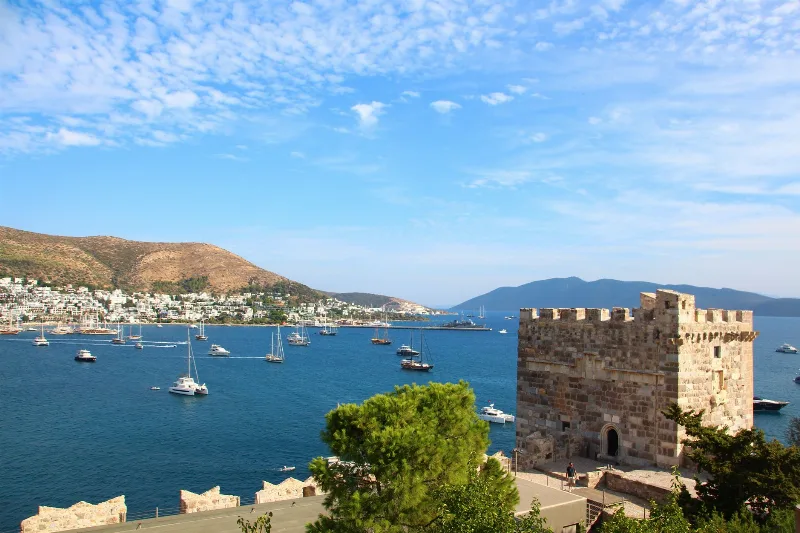
5-Day Bodrum Peninsula Route
A five-day circular drive around the Bodrum Peninsula that links the historic core of Bodrum with the southern shore village of Gümüşlük, the western town of Turgutreis and the northern villages of Yalıkavak, Göltürkbükü and Torba.
Explore →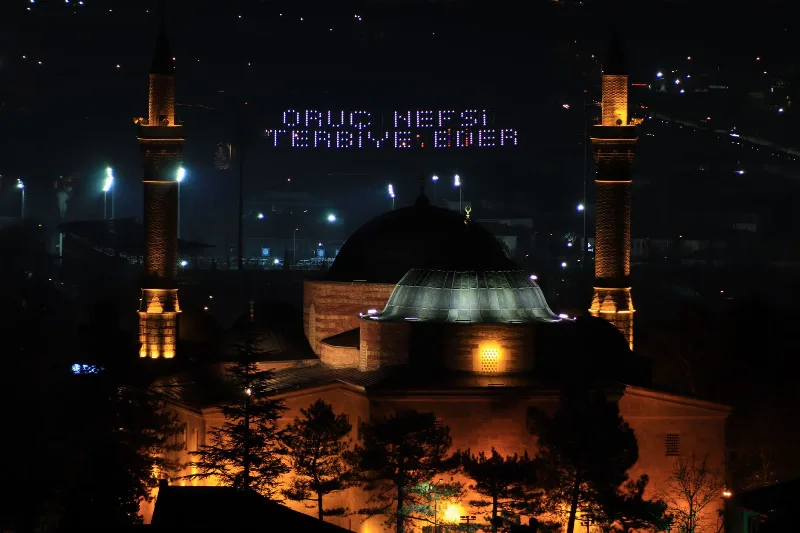
2-Day Bursa and Uludağ Route
A two-day route through Bursa's Ottoman monuments and up to the Uludağ National Park by cable car, combining city walking with mountain hiking or skiing.
Explore →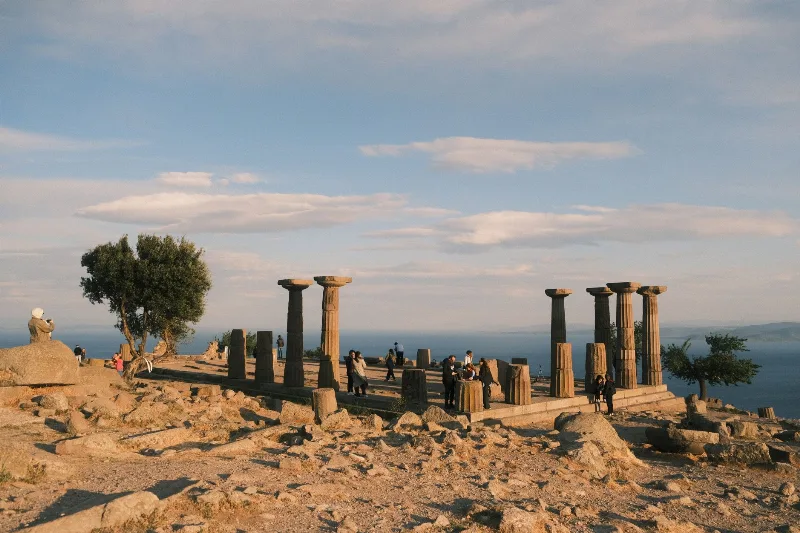
4-Day North Aegean Coast Route
A four-day linear route along the North Aegean coast from Assos to İzmir, with stops at Ayvalık, Cunda, Dikili, Çandarlı, Bergama and Foça. The itinerary is designed for a realistic coastal and inland road trip by car.
Explore →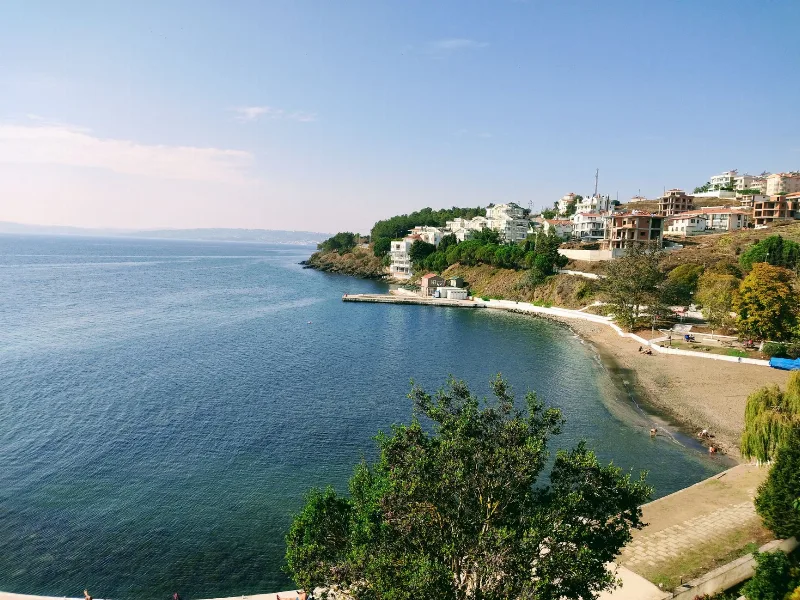
5-Day Black Sea Coast Route
A five-day linear journey along Türkiye's central and eastern Black Sea coast, from Sinop to Trabzon, with an inland detour to Amasya and stops in Ordu and Giresun along the way.
Explore →Related content
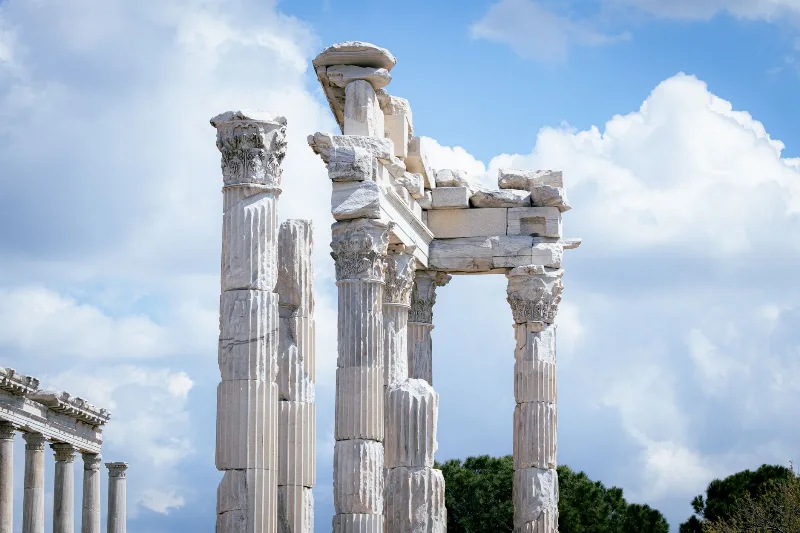
Bergama
Bergama is an inland district of İzmir Province on the Bakırçay plain, built around the ancient city of Pergamon, a UNESCO World Heritage Site reached by a cable car up to its acropolis.
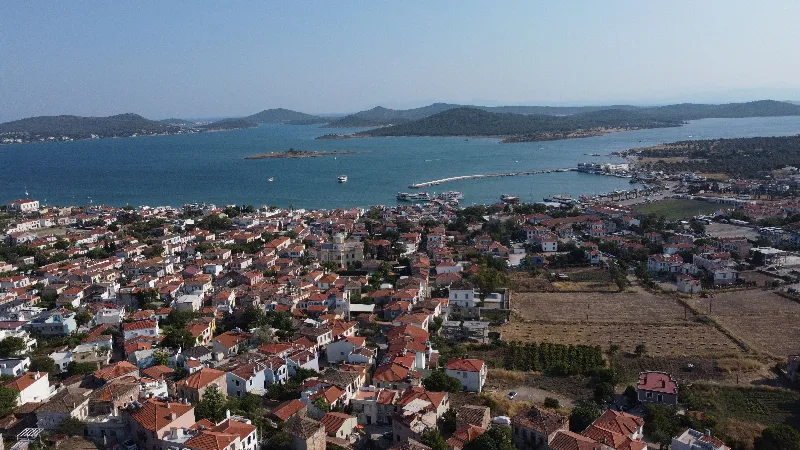
Ayvalık
Ayvalık is a coastal district of Balıkesir Province in western Türkiye, known for its olive oil, its Greek-influenced old town and the offshore island of Cunda.
2-Day Bergama and Ayvalık Route: Pergamon to Cunda Island
A compact two-day route that pairs the terraced ruins of ancient Pergamon in inland Bergama with the olive-growing Aegean coast at Ayvalık and the causeway-linked island of Cunda.
4-Day North Aegean Coast Route
A four-day linear route along the North Aegean coast from Assos to İzmir, with stops at Ayvalık, Cunda, Dikili, Çandarlı, Bergama and Foça. The itinerary is designed for a realistic coastal and inland road trip by car.
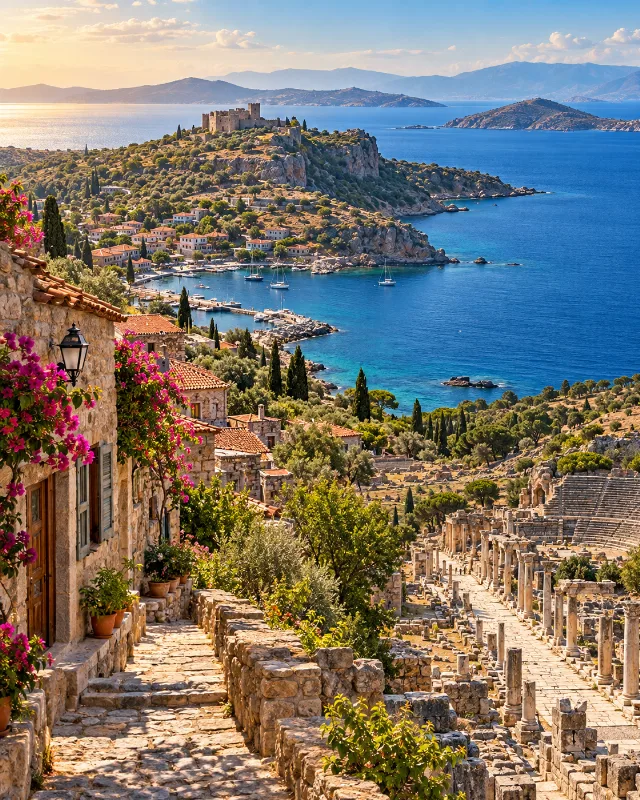
7-Day North Aegean to Ephesus Route
A seven-day southbound route through Troy, Assos, Bozcaada, Ayvalık, Bergama, İzmir and Ephesus, combining archaeology, coastal towns and Aegean culture.
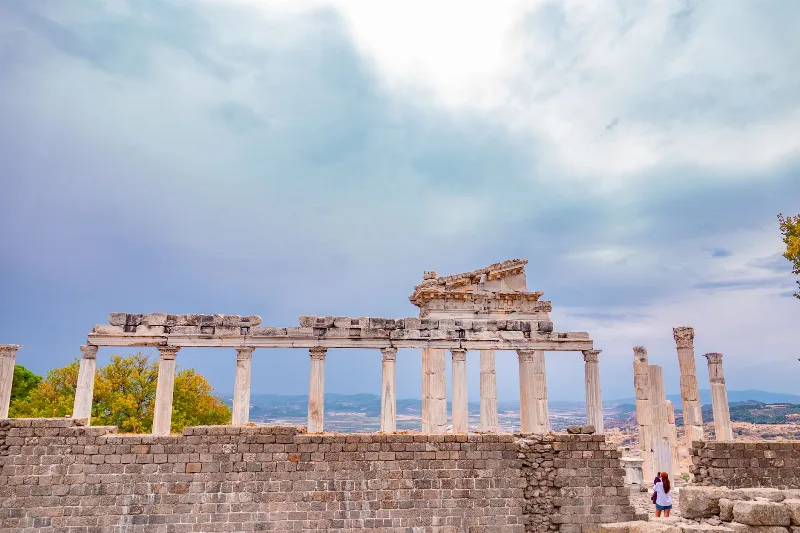
Pergamon
Pergamon is an ancient Greek city in Aeolis, today the modern town of Bergama in İzmir Province, Türkiye. Its acropolis, library and Great Altar of Zeus, together with the Asclepion healing sanctuary, form one of the most important archaeological settings in the eastern Mediterranean.