
Bazlama
Bazlama is a soft, thick Turkish flatbread made from a leavened dough and cooked on a hot griddle. It is a staple of village baking across Anatolia, eaten warm with butter or used to wrap other foods.
Bazlama is a soft, round Turkish flatbread made from a leavened wheat-flour dough. It is noticeably thicker and spongier than thin breads such as yufka or lavash, with a pale, lightly blistered crust and a tender, bread-like crumb. It is cooked quickly on a heated convex griddle known as a saç, or in a tandır oven, and it belongs above all to the home-baking tradition of Anatolian villages, where it is eaten warm with butter, cheese or jam, or used as a wrapper for meat and vegetables.
What Kind of Bread Bazlama Is
The defining feature of bazlama is that it is a yeast-leavened bread rather than a thin, rolled sheet. Where yufka is stretched almost paper-thin and dries into a brittle sheet, bazlama is left with real depth — usually somewhere around two to three centimetres before baking — so that the heat of the griddle sets the outside while the inside steams and puffs. The result is a bread that behaves more like a small loaf than like a crisp flatbread: it can be split, folded, torn or pressed into a stew without falling apart.
Because it is leavened and relatively thick, bazlama needs a resting period before it is shaped, which places it in the same family of slow, household bread-making as tandır ekmeği and ordinary village loaf bread, rather than in the quick, rolling-pin traditions of gözleme and katmer.
Where Bazlama Belongs Culturally
Bazlama is not tied to a single province. It is made in villages and small towns across much of Anatolia, and that wide distribution is part of its identity: it is a domestic bread, associated with the household hearth, the shared baking day and the courtyard griddle rather than with a particular city's commercial food culture. Attempts to assign it to one region tend to say more about local pride than about documented history, and no single point of origin is reliably established.
What is well established is its role. In village life, bread is rarely bought; it is made in batches, and bazlama is one of the forms that can be produced quickly once the dough has risen. It appears in markets and small bakeries as well, but its strongest association remains with home production, where the size, thickness and browning are matters of household preference rather than fixed standards.
The Dough and Its Ingredients
The basic dough is simple: wheat flour, water, salt and a leavening agent. Many households use commercial yeast, while others keep back a piece of dough from the previous batch or maintain a sour starter to raise the next. The dough is mixed and kneaded until it is smooth and elastic, then left to rise until visibly puffy. Because the ingredient list is so short, differences between one village and another come down to flour type, hydration, how long the dough is allowed to prove and how hot the cooking surface is.
Some households work in a little oil or milk for a softer crumb, and wholemeal or partly wholemeal flour is used where it is available. These are variations rather than requirements; the plain flour-and-water version is the reference point.
How Bazlama Is Traditionally Cooked
Once risen, the dough is divided into pieces and shaped by hand into rounds. Each round is flattened on a lightly floured surface into a disc, then lifted onto a hot, dry griddle. The saç — a shallow convex metal plate set over a fire or a gas burner — is the classic cooking surface, though a heavy flat pan or the wall of a tandır may be used instead.
The bread is cooked fast. Within a minute or two the underside sets and takes on dark brown spots, the disc puffs slightly, and it is turned so the second side can colour. The whole process takes only a few minutes per bread, which is why bazlama suits a household that needs a stack of fresh bread quickly. It is normally eaten the same day; once cool it firms up, and stale pieces are often softened over steam or folded into other dishes rather than discarded.
Texture, Flavour and Appearance
A good bazlama is soft and pliable, with a thin, dry crust marked by irregular browned patches and a few darker blisters where the dough met the hot metal. The interior is pale, airy and slightly moist, closer to a tender white loaf than to a cracker. The flavour is mild and wheaty, with a faint sweetness from the flour and, in a sour-starter version, a gentle tang. It is not a strongly flavoured bread, and that neutrality is precisely why it works as a companion to strong cheeses, grilled meat, oily stews and honeyed breakfast spreads.
How Bazlama Is Served
Bazlama is at its best warm and slightly puffed, straight from the griddle. At breakfast it may be torn open and spread with butter, white cheese, jam or honey, and it often stands in for sliced bread alongside tea. At other meals it appears with soups, bean dishes, vegetable stews and grilled meats, used to scoop up sauce and soak up juices.
Its other major role is as a wrapper. Because it is thick enough to hold its shape, bazlama can be folded around döner, köfte, grilled vegetables, cheese or herbs, functioning as an edible container in the way that thinner breads cannot. It can also be split open and filled, warmed over a fire before serving, or cut into pieces and dried for later use.
Regional and Household Variations
Bazlama varies more by household than by province. Diameter ranges from small individual rounds to wide discs the size of a large plate, and thickness is adjusted according to how the bread will be used — thinner for wrapping, thicker for eating with butter. Some cooks prefer a soft, pale bread pulled off the heat early, others a more thoroughly browned one with a firmer crust.
In several regions a filled version is made, in which the dough is rolled out, spread with a seasoned filling such as minced meat or cheese and herbs, covered with a second layer and cooked on the same griddle. These filled breads sit somewhere between bazlama and gözleme and are usually treated as a dish in their own right rather than as a variation on plain bread.
Bazlama and Similar Breads
The clearest distinction is with yufka, which is rolled extremely thin, unleavened or barely leavened, and dried for keeping. Bazlama is thick, yeasted and eaten fresh. Gözleme is also cooked on a saç, but it is stretched thin and folded around a filling, so the bread and the filling are one dish. Tandır ekmeği is baked against the inside wall of a clay oven, which gives it a different shape and a drier, more blistered surface. Pide is an oval bread, often enriched and baked in a stone oven, and frequently topped. Lavash, found across the wider region, is thin and pliable by comparison.
Bazlama in Everyday Life
Because it demands nothing more than flour, water, salt, leavening and a hot surface, bazlama remains one of the most practical breads in rural Anatolia. It is associated with mornings when the griddle is set up outdoors and several households bake together, and with the simple domestic expectation that fresh bread should be available without a trip to a shop. For anyone interested in Turkish bread beyond the restaurant basket, bazlama is the clearest example of the soft, griddle-cooked, everyday loaf that village kitchens have produced for generations.
Related content
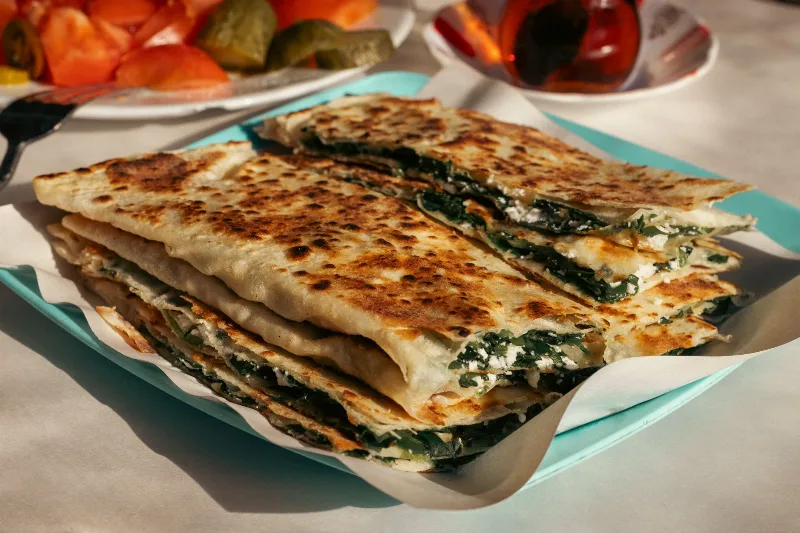
Gözleme
Gözleme is a thin, hand-rolled Anatolian flatbread folded around savory fillings such as cheese, spinach, or minced meat and cooked on a sac griddle. The article covers its regional variations, cooking method, texture, and traditional serving style.
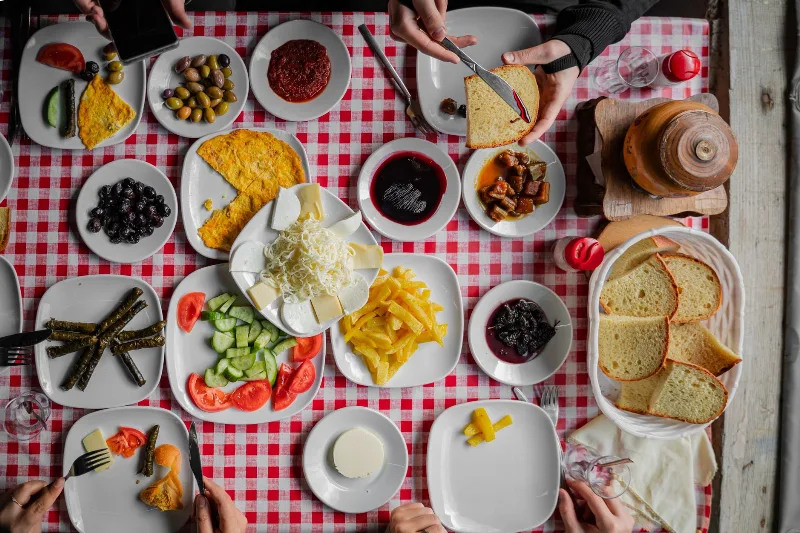
The Traditional Turkish Breakfast Spread Across Türkiye
Turkish breakfast, or kahvaltı, is a leisurely morning meal of cheeses, olives, breads, and teas that reflects Türkiye's regional diversity and communal spirit.
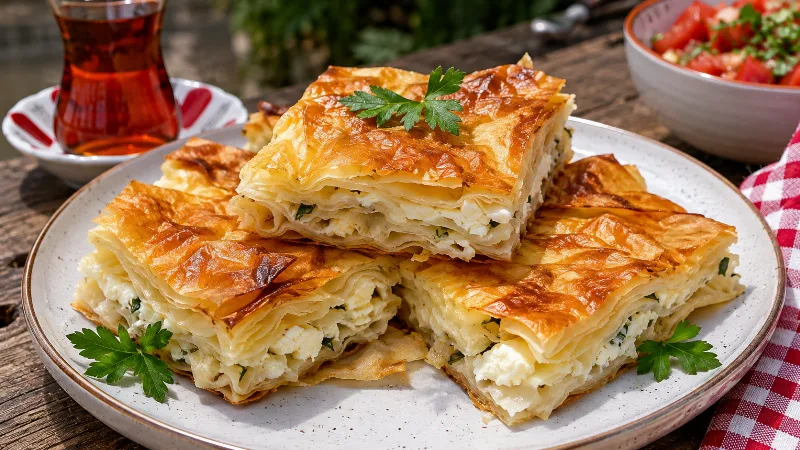
Su Böreği
Su Böreği is a layered Turkish savory pastry made by briefly boiling thin yufka sheets, then baking them with cheese and parsley. Its soft interior and golden top distinguish it within the wider börek family.
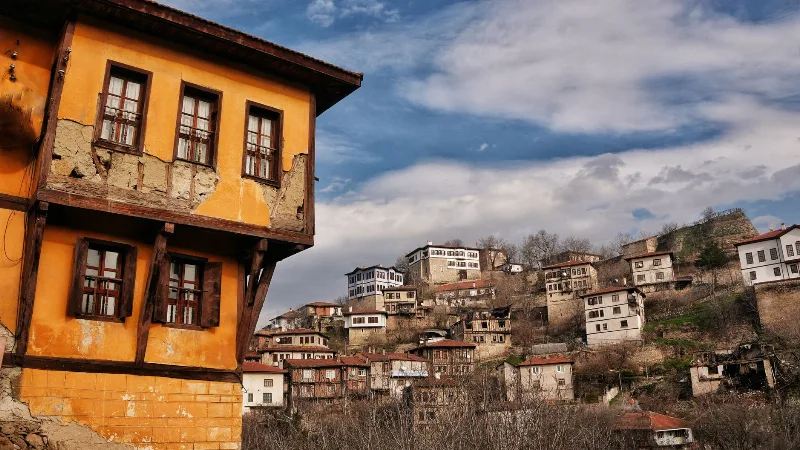
Traditional Villages of Türkiye
Türkiye's traditional villages blend stone houses, timber balconies and seasonal customs into landscapes that reveal the country's rural heritage.

Sailing the Turquoise Coast
The Turquoise Coast follows the southwestern shoreline of Türkiye, where sheltered bays, pine hills and clear water meet. This page explores how sailing and boat trips reveal its landscapes, islands and ancient harbours.

Cultural Festivals in Türkiye
Türkiye's year is marked by festivals that celebrate spring, faith, harvest and history, from Hıdırellez bonfires to the whirling ceremonies of Konya.