
Hierapolis Ancient City and Thermal Pools
Hierapolis is an ancient city in Türkiye whose Greco-Roman ruins sit on a plateau above the white travertine terraces and warm mineral springs of Pamukkale.
Hierapolis is an ancient city in the Denizli province of Türkiye, built on a plateau above the bright travertine terraces of Pamukkale. Its name means "holy city," a reference to the sacred character the settlement held in antiquity and to the hot mineral springs that still rise to the surface here. Archaeology and thermal water belong to the same place, which is why the site draws travellers interested in Roman history, geology and warm springs at once.
A Sacred City Above the Springs
The city was founded in the second century BC, most likely by Eumenes II of Pergamon, and later grew into a prosperous Roman centre. A severe earthquake in 60 AD damaged much of Hierapolis, and the city was rebuilt in the decades that followed under imperial support. It remained important through the Byzantine period, when it became a bishopric, before being gradually abandoned after later earthquakes and shifting settlement patterns. Its ruins preserve streets, gates, baths and tombs that show how a Roman city on a hot spring was organised.
The Travertine Terraces of Pamukkale
Water emerging from deep faults is rich in calcium bicarbonate. As it reaches the surface and cools, it releases carbon dioxide and deposits calcium carbonate, creating the white cascading basins known as Pamukkale, or "cotton castle" in Turkish. The terraces form a pale cliff above the plain, and the same chemistry that produced them continues to shape the site. Sections of the terraces are protected, and walking routes keep visitors on designated paths so the delicate mineral surfaces are not damaged.
Thermal Pools and the Antique Pool
Springs around the ancient city flow at roughly 35°C, warm enough to be comfortable throughout much of the year. The best-known feature is the Antique Pool, where fallen marble columns rest beneath the water, a reminder that bathing here has deep roots. In antiquity, Hierapolis was associated with the therapeutic use of mineral water, and the Roman baths were a central part of daily life. Today the warm pools remain one of the reasons the area is known, alongside the archaeology itself.
Monuments Across the Site
Visitors encounter a series of well-preserved structures. The Frontinus Gate opens onto a long colonnaded street that cuts through the city centre. The theatre, set into the hillside, once seated thousands of spectators and still shows its tiered seating and stage buildings. The Sanctuary of Apollo includes the Plutonium, a small cave opening that releases carbon dioxide and was linked to rituals in antiquity. Elsewhere, the North Necropolis spreads across the hillside with a wide variety of tomb types, while the Martyrium of St. Philip on the ridge above the city marks its later Christian history. Public latrines, bath complexes and fountains add further detail to the urban plan.
Landscape and Setting
Hierapolis overlooks the Lycus valley, part of the wider Büyük Menderes basin, where fields and low hills stretch toward distant mountains. The plateau gives wide views across the plain, and the contrast between white travertine, grey stone ruins and green farmland defines the setting. The site was inscribed on the UNESCO World Heritage List together with Pamukkale in 1988, recognising both the natural terraces and the ancient city they border.
Related content
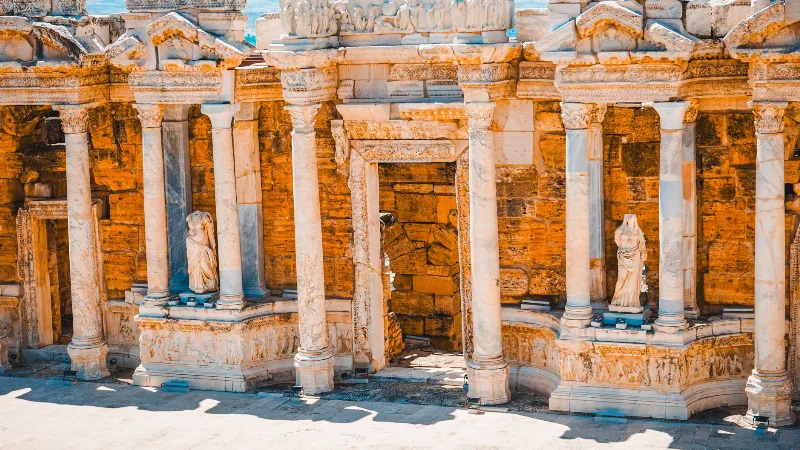
Hierapolis
Hierapolis is an ancient city in Denizli Province, Türkiye, built beside the hot springs and travertine terraces of Pamukkale. Its Roman theatre, vast necropolis, baths and the sanctuary of Apollo make it one of the most extensively preserved Greco-Roman cities in Anatolia and a UNESCO World Heritage Site.
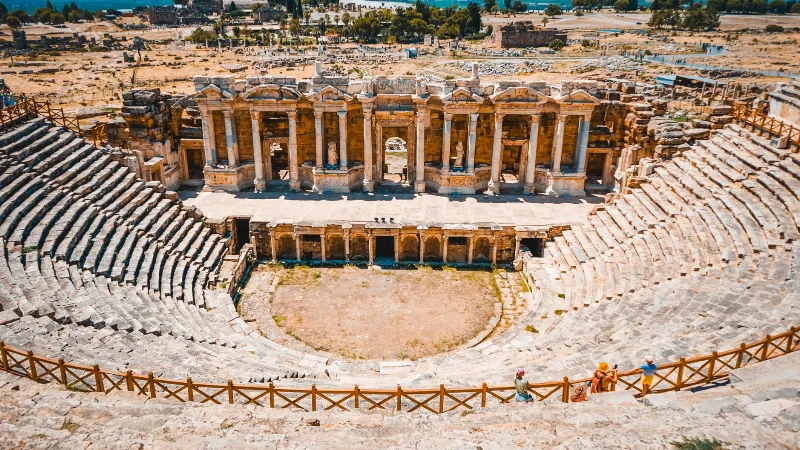
Hierapolis
Hierapolis is an ancient Graeco-Roman city built directly on the plateau above the travertine terraces of Pamukkale in southwestern Türkiye. Its thermal springs, the Plutonium, the necropolis and the martyrion of Philip made it one of the most distinctive sanctuaries of the ancient world.
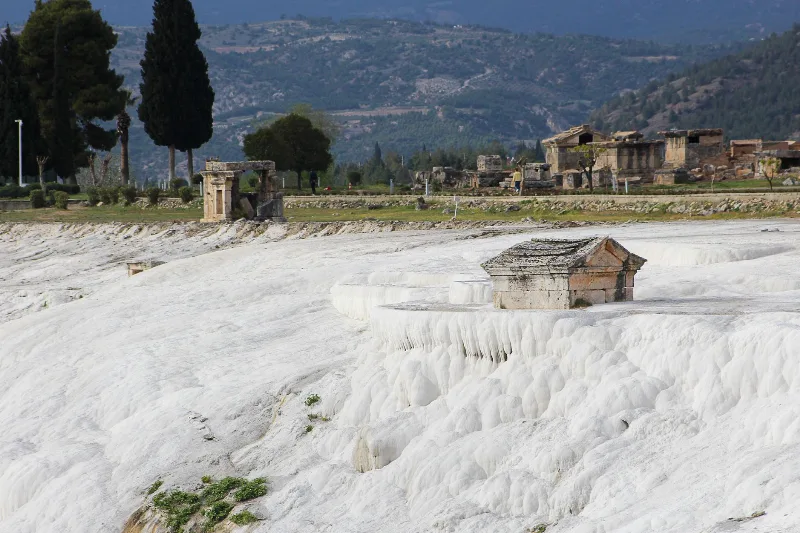
Pamukkale
Pamukkale, Türkiye'nin en etkileyici doğal harikalarından biri olarak bilinir, büyüleyici beyaz termal terasları ve antik Hierapolis kentiyle dikkat çeker.
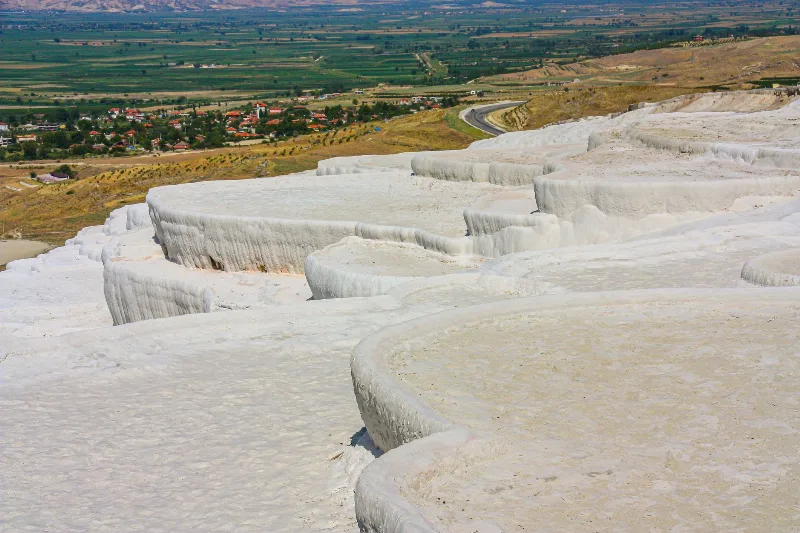
The Natural Wonders of Pamukkale
Pamukkale in Denizli, Türkiye, is a hillside of white travertine terraces and warm mineral springs that has been shaped by geology for millennia.
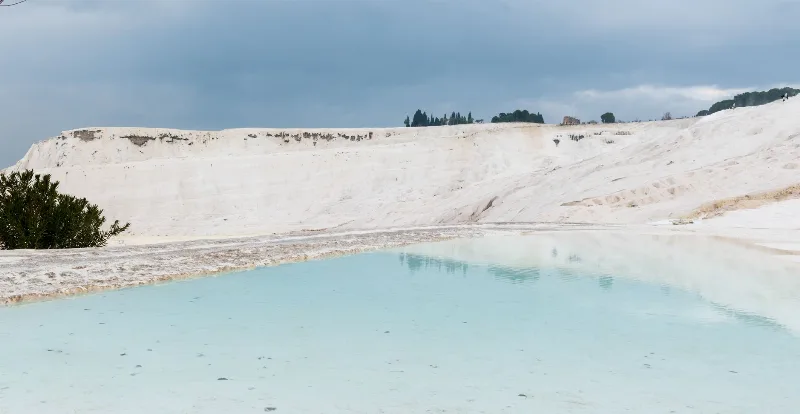
Pamukkale Travertines
Discover the mesmerizing beauty of Pamukkale's travertine terraces and thermal waters, a unique natural wonder in Türkiye.
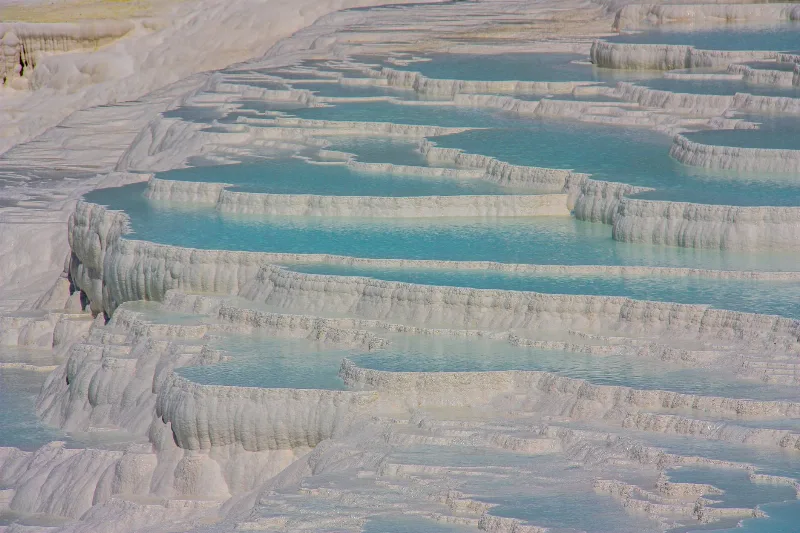
Pamukkale
Pamukkale is a white travertine formation in Denizli Province, built up over millennia by calcium-rich thermal springs that flow down the edge of a plateau beside the ancient city of Hierapolis.
Pamukkale
Pamukkale in Denizli province is a UNESCO World Heritage site where calcium-rich thermal water has built a cliff of white travertine terraces above the ancient city of Hierapolis. Visitors walk barefoot across the terraces, while the plateau above holds Roman baths, a theatre, the Plutonium and one of Anatolia's largest necropolises.
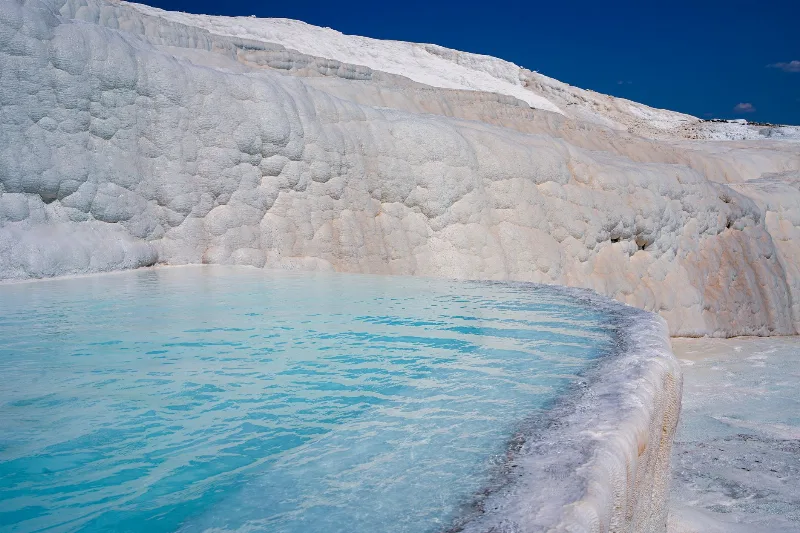
Exploring the Beauty of Pamukkale's Terraces
Discover the unique geological formations and thermal springs of Pamukkale, a remarkable natural wonder in Türkiye.