
Pamukkale
Pamukkale is a white travertine formation in Denizli Province, built up over millennia by calcium-rich thermal springs that flow down the edge of a plateau beside the ancient city of Hierapolis.
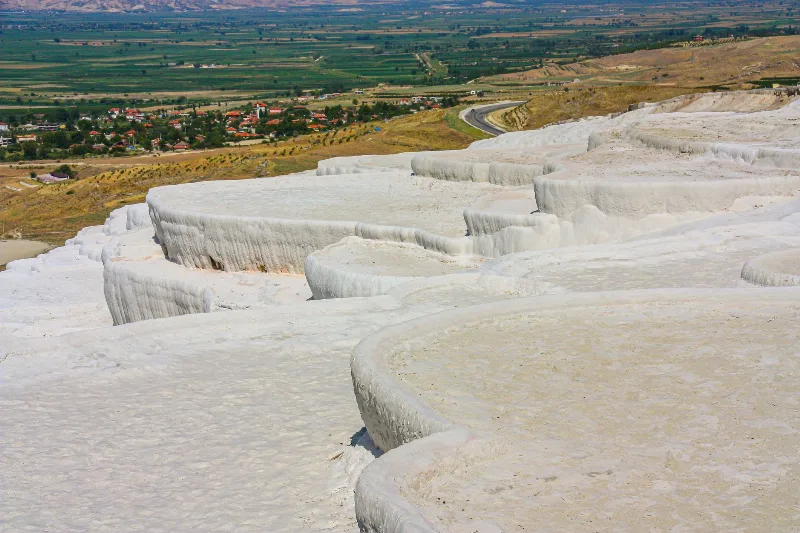
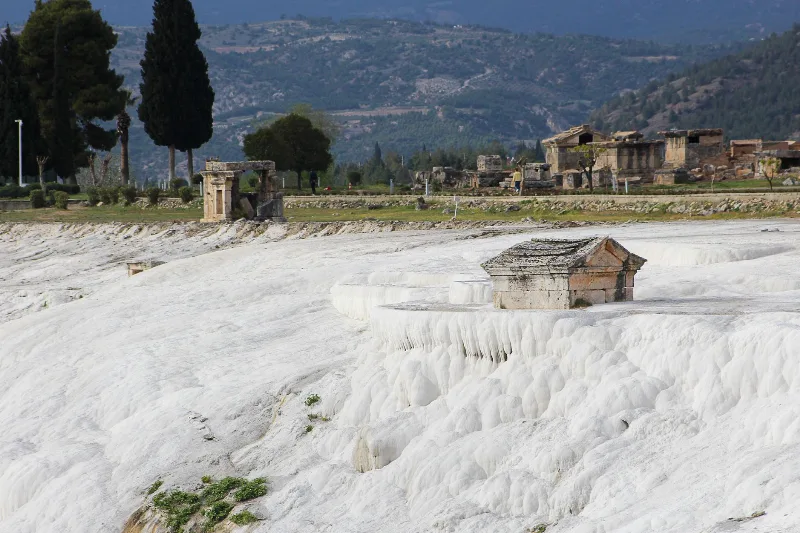
Pamukkale is a travertine formation in Denizli Province in western Türkiye, roughly 18 to 20 kilometres north of the city of Denizli and directly above the village that carries the same name. It consists of a long series of white, stepped basins spread across the edge of a plateau, produced by thermal water that rises from springs near the top of the slope. The water is warm, around 35°C at the point where it emerges, and carries a high load of dissolved minerals. As it cools and flows downward it leaves behind calcium carbonate, which over thousands of years has built the terraces themselves. The formation sits immediately beside the ruins of Hierapolis, and the two are managed as one protected site.
The Travertine Slope and Its Setting
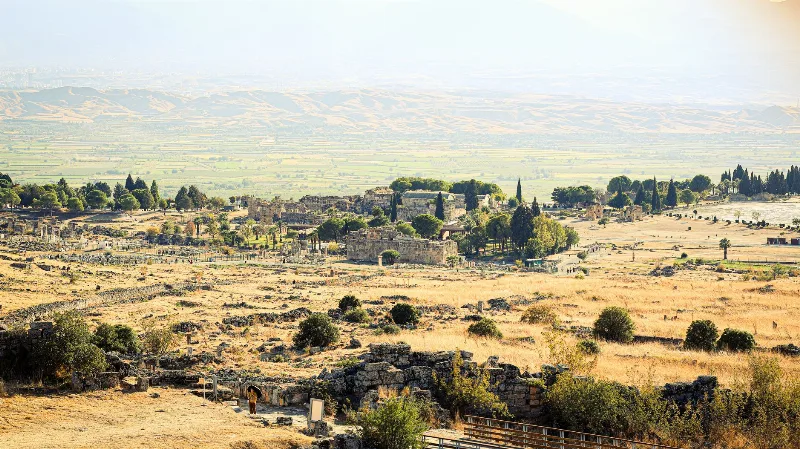
The formation lies on the northern margin of the Çürüksu plain, a broad agricultural valley in inland Denizli. The travertine runs for about 2,700 metres from one end to the other along the hillside and falls roughly 160 metres in a sequence of stepped basins before reaching the level ground below. Seen from the valley, it reads as a pale band cutting across an otherwise dark slope of scrub and farmland. Above the white surface the land flattens onto the plateau where Hierapolis was built, and it is from this higher ground that the springs feed the terraces.
How the Terraces Are Formed
The spring water begins its journey as rainfall that seeps through limestone and marble in the surrounding hills, dissolving calcium bicarbonate as it travels. When the water reaches the surface, carbon dioxide escapes into the air and the dissolved mineral is deposited as solid calcium carbonate. The process is chemical rather than biological, and it happens quickly wherever the water spreads into a thin sheet. Small natural rims of hardened calcite form at the edges of each pool, holding back shallow water and encouraging further deposition at exactly that line. The result is the characteristic ribbed, shell-like pattern of the terraces, with a surface that is renewed at the top and gradually thickens and hardens as it ages downslope.
What the Terraces Look Like Close Up
The pools are shallow, often only a few centimetres deep, and are held behind low lips of precipitated calcite that are firm enough to walk on. The material feels like rough stone rather than anything soft, though its rounded, rippled shapes give it a waxy appearance from a distance. Colour shifts considerably with the light: brilliant white in strong midday sun, cooler grey under cloud, and warm cream tones in the late afternoon. Where water moves slowly and stays warm, thin films of algae tint parts of the surface green, and mineral traces leave pale brown streaks on older sections. Because the flow across the slope is distributed along different channels, some basins can be full while others nearby stand dry at the same moment.
Water Flow and the Condition of the Site
In the later twentieth century the terraces suffered serious damage. Buildings were constructed on the plateau, water was diverted for their use, and large sections of the travertine dried out, lost their pools and turned from white to a dull grey. After the site was inscribed on the UNESCO World Heritage list in 1988, together with Hierapolis, the buildings were removed and the water was directed back across the formation. The flow is now managed rather than left entirely to itself, which is why the appearance of individual terraces is not identical from one year to the next.
Seasons and Weather
Denizli has an inland climate with hot, dry summers and cooler, wetter winters. Summer daytime temperatures frequently climb above 35°C, and the white surface reflects a great deal of light, so heat and glare are the main natural conditions to plan around. Winter is mild by comparison but can bring rain, occasional frost and, rarely, light snow on the plateau, when the contrast between the warm steaming water and the cold air becomes most obvious. Spring is generally the period when the surrounding hills are greenest and the water flow is at its most consistent, while autumn offers steadier temperatures. The spring water itself stays close to 35°C throughout the year, so steam rises from the pools on cold mornings regardless of the season.
Vegetation and Surrounding Landscape
The travertine surface is bare by nature; almost nothing grows on the actively depositing calcite. The plateau above carries dry scrub and planted trees around the Hierapolis area, while the plain below is cultivated, with cotton fields, vineyards, orchards and small settlements spread across the valley floor. The wider hills around Denizli are covered in the drought-tolerant scrub typical of inland western Anatolia, which turns brown in high summer and green again after the autumn and winter rains. This contrast between cultivated lowland, dry hillside and bare white rock is a large part of what makes the setting distinctive.
Reaching the Site and Moving Around It
The site is reached by road from Denizli, a drive of roughly twenty kilometres, and it can be entered either from the village at the foot of the slope or from the plateau above near the ruins of Hierapolis. Movement across the travertine itself is on foot, and footwear is removed on the section where walking over the terraces is permitted, partly to protect the fragile surface and partly because the wet calcite is slippery. The walking area is uneven and hard underfoot. Beyond the terraces, the plateau extends towards the ancient city, so the site as a whole involves a reasonable amount of walking between its lower and upper levels.
Practical Natural Conditions
Because there is almost no shade on the white slope, sun exposure is intense for much of the day, and the reflected light from the calcite is stronger than most visitors expect. The barefoot section requires care where the surface is wet, and the shallow pools are warm rather than cool. Early morning and late afternoon bring softer light and lower temperatures. Visitors should assume they will be walking on hard, ridged stone for part of the visit and that weather in the valley below can differ from conditions on the exposed plateau.
Conservation Status
Pamukkale and Hierapolis form a single UNESCO World Heritage Site, inscribed in 1988 as a mixed cultural and natural property. The travertine is also protected under Turkish legislation as part of the wider archaeological and natural area, which is why construction, water use and access on the formation are controlled.
Other Natural Features in the Area
A few kilometres north of Pamukkale, the springs at Karahayıt emerge at a similar temperature but with a different mineral content, leaving reddish and ochre deposits instead of white ones. South of the Çürüksu plain rises Honaz Dağı, the highest mountain in the immediate Denizli area, whose forested slopes contrast sharply with the bare travertine. Further south, beyond the provincial boundary in Burdur, Lake Salda is a separate and quite different landscape, known for its white mineral shoreline and clear water.
Beaches & bays
See the coast →
Related content
Denizli
Denizli is the inland capital of Denizli Province in Türkiye's Aegean region, known internationally for the Pamukkale travertine terraces and ancient Hierapolis, and at home as a major textile city with its own long-crowing rooster breed.
Hierapolis
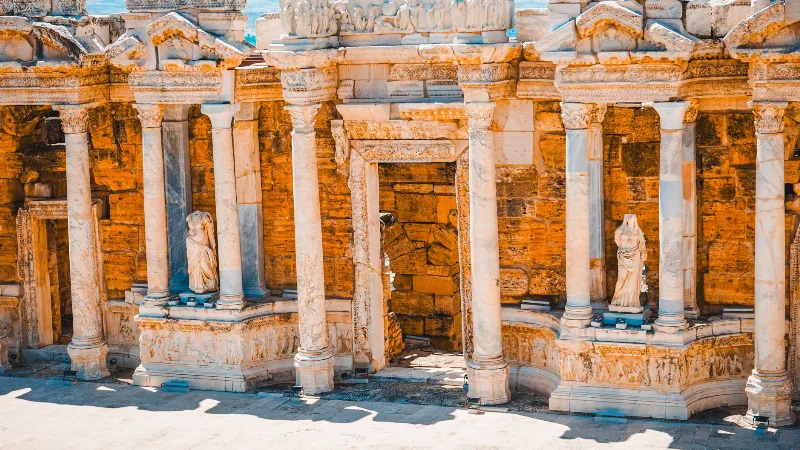
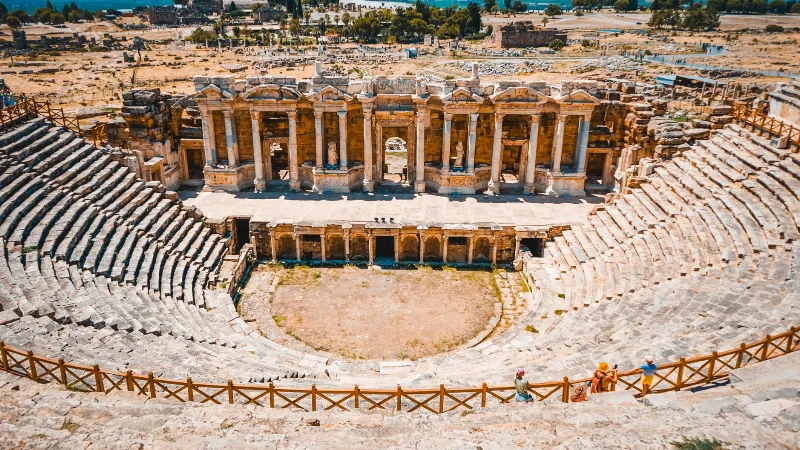
Hierapolis is an ancient city in Denizli Province, Türkiye, built beside the hot springs and travertine terraces of Pamukkale. Its Roman theatre, vast necropolis, baths and the sanctuary of Apollo make it one of the most extensively preserved Greco-Roman cities in Anatolia and a UNESCO World Heritage Site.
Hierapolis
Hierapolis is an ancient Graeco-Roman city built directly on the plateau above the travertine terraces of Pamukkale in southwestern Türkiye. Its thermal springs, the Plutonium, the necropolis and the martyrion of Philip made it one of the most distinctive sanctuaries of the ancient world.
4-Day Ephesus and Pamukkale Route
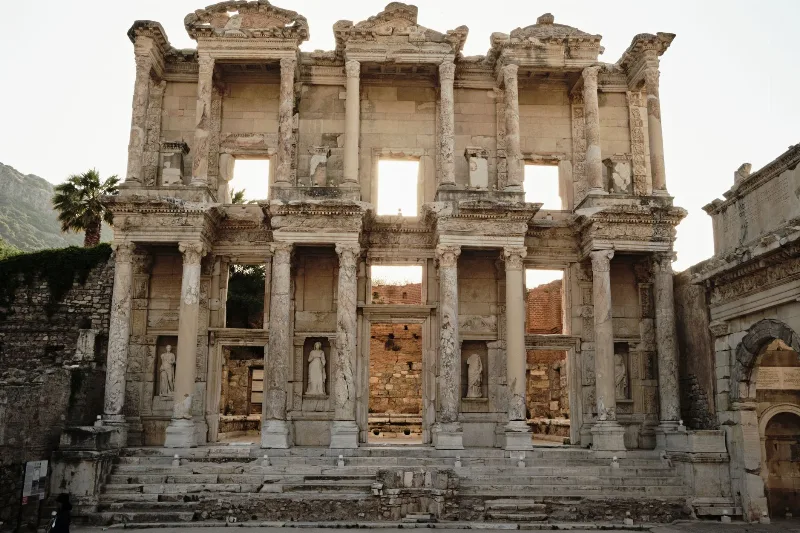
A four-day west-to-east Aegean route that links the ancient city of Ephesus and the House of Virgin Mary in Selçuk with the white travertine terraces and Hierapolis ruins at Pamukkale, near Denizli.
The Natural Wonders of Pamukkale
Pamukkale in Denizli, Türkiye, is a hillside of white travertine terraces and warm mineral springs that has been shaped by geology for millennia.
Pamukkale
Pamukkale, Türkiye'nin en etkileyici doğal harikalarından biri olarak bilinir, büyüleyici beyaz termal terasları ve antik Hierapolis kentiyle dikkat çeker.