
Hierapolis
Hierapolis is an ancient Graeco-Roman city built directly on the plateau above the travertine terraces of Pamukkale in southwestern Türkiye. Its thermal springs, the Plutonium, the necropolis and the martyrion of Philip made it one of the most distinctive sanctuaries of the ancient world.
Hierapolis is an ancient Graeco-Roman city built on a plateau immediately above the white travertine terraces of Pamukkale, in the Denizli Province of southwestern Türkiye. The settlement and the landscape are inseparable: the same hot, mineral-rich springs that deposited the terraces also gave the city its wealth, its cults and its reputation. The name means sacred city, and that idea governed almost everything about the place. Since 1988 the ruins and the terraces have together formed a single UNESCO World Heritage Site.
Where Hierapolis Stands
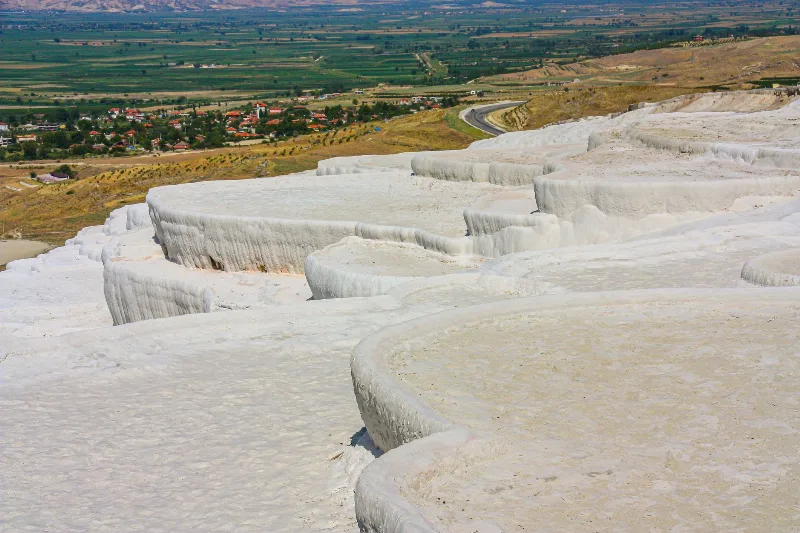
The city occupies a broad limestone plateau at the northern edge of the Çürüksu plain, the valley the ancients called the Lycus. Below it, the travertine terraces run down the slope for roughly 2.7 kilometres and drop about 160 metres towards the modern town of Pamukkale. Denizli, the nearest large city, lies around 20 kilometres to the south. The site sits in the Büyük Menderes rift system, a geologically active zone that explains both the hot springs and the earthquakes that repeatedly damaged the city.
The setting also explains its ancient importance. Hierapolis stood on a natural route between the Aegean coast and the interior of Anatolia, close to Laodicea on the Lycus and Colossae, two other cities of the same valley that are mentioned together in early Christian texts.
Foundation and Historical Outline
The city is generally attributed to the Attalid kings of Pergamon, most often to Eumenes II, in the early second century BC, although the precise foundation date is debated. It passed to Rome in 133 BC when the Pergamene kingdom was bequeathed to the Roman people, and it grew into a prosperous provincial centre. A major earthquake in 60 AD, during the reign of Nero, levelled much of Hierapolis; the city was rebuilt and its monumental centre largely dates from that later period. It remained inhabited through the Byzantine era, when it became a bishopric, and was gradually abandoned after further earthquakes and the shifting of regional power in the medieval period.
The Plutonium and the Sacred Springs
The most unusual feature of Hierapolis was the Plutonium, a small cave opening in the ground from which carbon dioxide and other gases escape continuously. Ancient writers, Strabo among them, described how animals led into the opening died almost instantly while the priests of the sanctuary survived. The cave was understood as a gateway to the underworld, dedicated to Pluto and Kore, and it stood beside a temple of Apollo in the sacred core of the city. The vapours are a genuine geological phenomenon produced by the same fault system that feeds the hot springs. The Plutonium was later blocked and forgotten, and its location was only identified again during excavations in 2013, when the site was cleared and the temple area re-examined.
The Necropolis
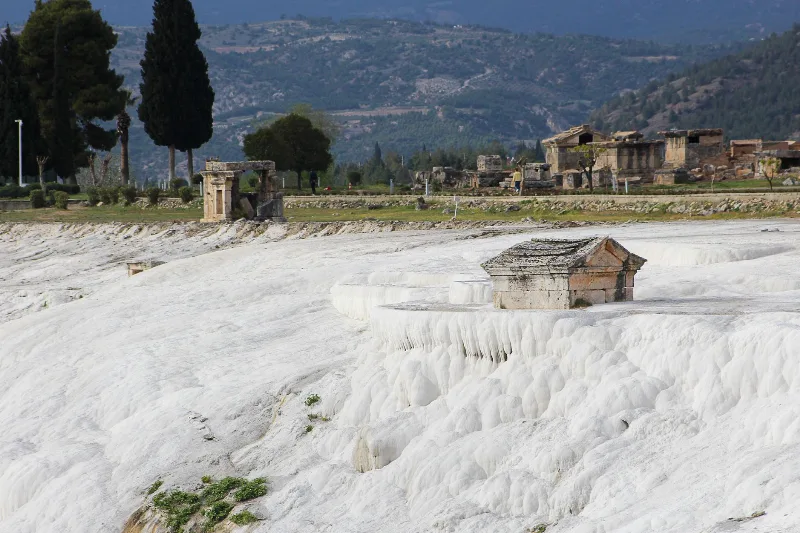
Hierapolis has one of the largest and best-preserved necropolises in Anatolia. It stretches for roughly two kilometres along the roads leading out of the city and contains more than a thousand tombs. Because the site was never built over by a later settlement, the burial ground survived intact. Visitors walk past tumuli, house-shaped tombs, sarcophagi and family plots, with inscriptions and reliefs still legible on many of them. The variety reflects the mixed population of the city: Greek, Roman, Jewish and early Christian communities were all present.
The Theatre, Streets and Monuments
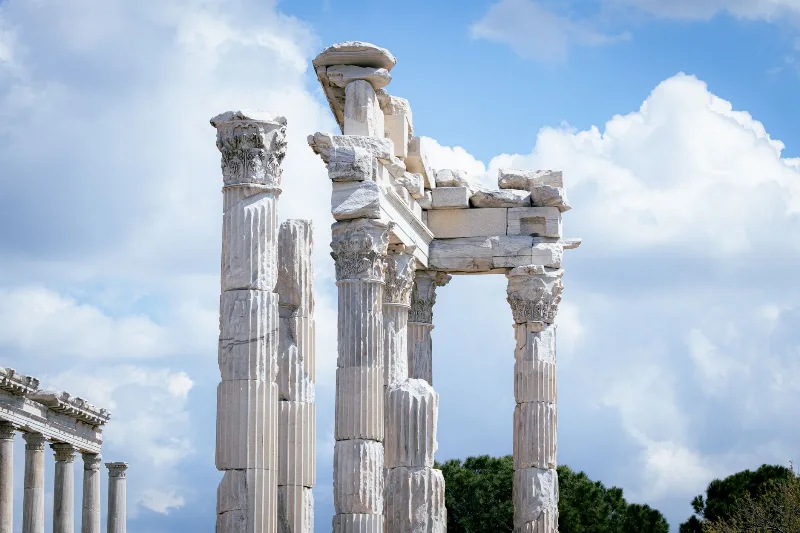
The Roman theatre is the most complete structure on the site. Built under Hadrian and renovated under Septimius Severus, it could hold roughly 15,000 spectators. Its stage building carries relief sculptures depicting Apollo and Artemis alongside mythological scenes. Below the theatre, the city's main axis is the colonnaded street known as Frontinus Street, which runs between the North Byzantine Gate and the Gate of Domitian. Along it stand the ruins of a nymphaeum, a monumental latrine, shops and the Temple of Apollo. Further west lie the North Agora, the Plutonium complex and the extensive Roman baths.
The Martyrion of Philip the Apostle
Christian tradition connects Hierapolis with Philip the Apostle, who is said to have been martyred there. An octagonal martyrium, built in the fourth or fifth century on a hill outside the city walls, is associated with his tomb. The building is unusual in plan and is one of the most significant early Christian monuments in western Anatolia. Hierapolis was also the seat of Papias, an early bishop whose writings are known only through later quotations.
The Travertine Terraces of Pamukkale
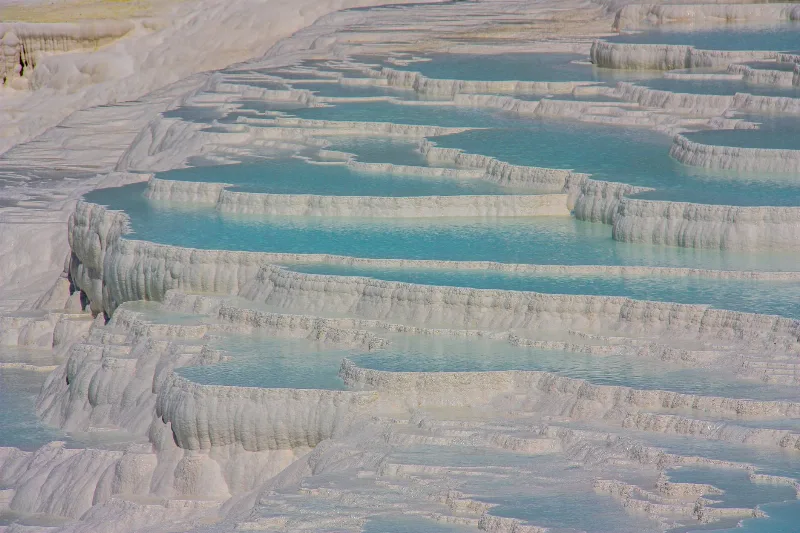
The terraces below the city are the result of calcium bicarbonate in the thermal water precipitating as calcite when it reaches the surface and releases carbon dioxide. The result is a series of white basins, ridges and cascades that give the place its Turkish name, meaning cotton castle. Water temperature at the springs is warm enough to bathe in year-round, and the terraces are actively growing where water still flows. Because the surface is fragile, visitors are required to remove their shoes before walking on the travertine, and some sections may be closed to protect them.
The Antique Pool and the Museum
Within the archaeological zone there is a thermal pool, sometimes called the Antique Pool, formed over fallen columns from a colonnade that collapsed during an earthquake. Swimming there is permitted, and the submerged marble fragments are visible beneath the water. The Roman bath building has been converted into the Hierapolis Archaeological Museum, which displays sculpture, sarcophagi, inscriptions and small finds not only from Hierapolis but also from Laodicea, Colossae, Tripolis and neighbouring ancient settlements.
Terrain, Walking and Accessibility
The site is large and spread over uneven ground. The main archaeological area runs along the plateau, while the terraces descend steeply to the town below. Walking from the town entrance up through the terraces to the city and then across to the theatre and necropolis involves a long, mostly uphill route over marble paving stones that can be polished and slippery. The southern gate at the top of the plateau allows visitors to enter at the highest point and walk downwards. Comfortable shoes with grip are useful, and the exposed white surfaces reflect strong sunlight.
Getting There and Practical Notes
Pamukkale and Hierapolis are reached by road from Denizli, about 20 kilometres away, where buses and minibuses connect the city with the site. Denizli Çardak Airport lies roughly 65 kilometres to the east and has domestic connections. The site has more than one entrance, and tickets cover the archaeological area, the terraces and the museum. Visiting hours vary through the year, and it is worth checking locally before travelling, as does the schedule of the Antique Pool. Photography is permitted, but drones and similar equipment are generally restricted.
When to Visit
Spring, from April to early June, and autumn, from September to October, offer the most comfortable conditions, with moderate temperatures and manageable crowds. Summer is very hot, and the white travertine reflects heat strongly, so early morning visits are considerably easier. Winter is milder but wet, and the terraces and marble streets can be slippery after rain. Early morning light also tends to be the most favourable for viewing the terraces before the day's visitors arrive.
Nearby Places Worth Knowing
Hierapolis sits in a dense archaeological landscape. Laodicea on the Lycus, a major Roman city with a large theatre, stadium and church, is close to Denizli and is often visited on the same trip. Colossae, smaller and largely unexcavated, lies further east in the same valley. Aphrodisias, with its remarkably preserved sculpture and stadium, is to the west in Aydın Province. The thermal springs at Karahayıt, a short distance north, are known for their red mineral water. Further south, Honaz Mountain National Park and Lake Salda offer contrasting natural scenery, while the modern city of Denizli provides the main transport hub for the whole region.
Related content
Pamukkale
Pamukkale, Türkiye'nin en etkileyici doğal harikalarından biri olarak bilinir, büyüleyici beyaz termal terasları ve antik Hierapolis kentiyle dikkat çeker.
Pamukkale
Pamukkale in Denizli province is a UNESCO World Heritage site where calcium-rich thermal water has built a cliff of white travertine terraces above the ancient city of Hierapolis. Visitors walk barefoot across the terraces, while the plateau above holds Roman baths, a theatre, the Plutonium and one of Anatolia's largest necropolises.
Pamukkale
Pamukkale is a white travertine formation in Denizli Province, built up over millennia by calcium-rich thermal springs that flow down the edge of a plateau beside the ancient city of Hierapolis.
Hierapolis Ancient City and Thermal Pools
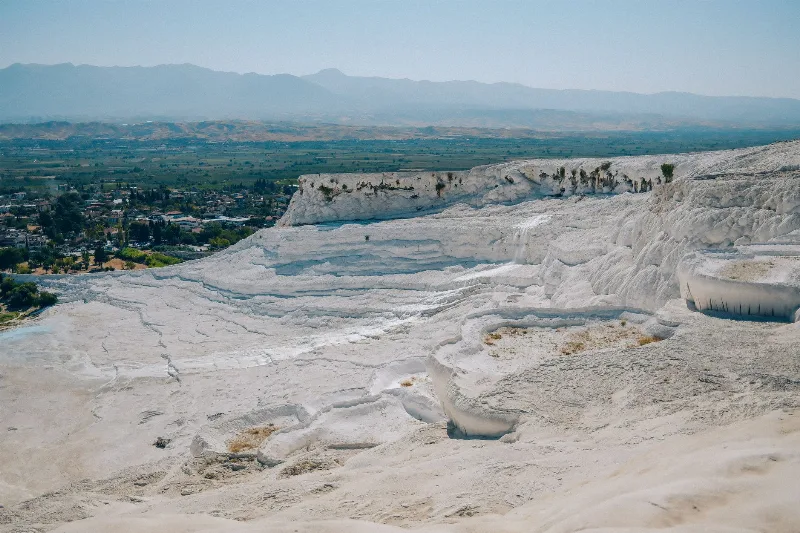
Hierapolis is an ancient city in Türkiye whose Greco-Roman ruins sit on a plateau above the white travertine terraces and warm mineral springs of Pamukkale.
The Natural Wonders of Pamukkale
Pamukkale in Denizli, Türkiye, is a hillside of white travertine terraces and warm mineral springs that has been shaped by geology for millennia.
4-Day Ephesus and Pamukkale Route
A four-day west-to-east Aegean route that links the ancient city of Ephesus and the House of Virgin Mary in Selçuk with the white travertine terraces and Hierapolis ruins at Pamukkale, near Denizli.