
Hierapolis
Hierapolis is an ancient city in Denizli Province, Türkiye, built beside the hot springs and travertine terraces of Pamukkale. Its Roman theatre, vast necropolis, baths and the sanctuary of Apollo make it one of the most extensively preserved Greco-Roman cities in Anatolia and a UNESCO World Heritage Site.
Hierapolis is an ancient city in Denizli Province, in southwestern Türkiye, built on a plateau directly above the white travertine terraces of Pamukkale. It was founded in the Hellenistic period and grew into a substantial Greco-Roman city in the Lycus River valley, a side valley of the Meander system. Its importance came from two things: a group of hot mineral springs that were believed to have healing powers, and a sanctuary associated with Apollo and with the underworld deity Pluto. Today Hierapolis is one of the most thoroughly excavated ancient cities in Anatolia, and it has been inscribed on the UNESCO World Heritage List since 1988, together with the travertine terraces of Pamukkale.
Location and Geographical Setting
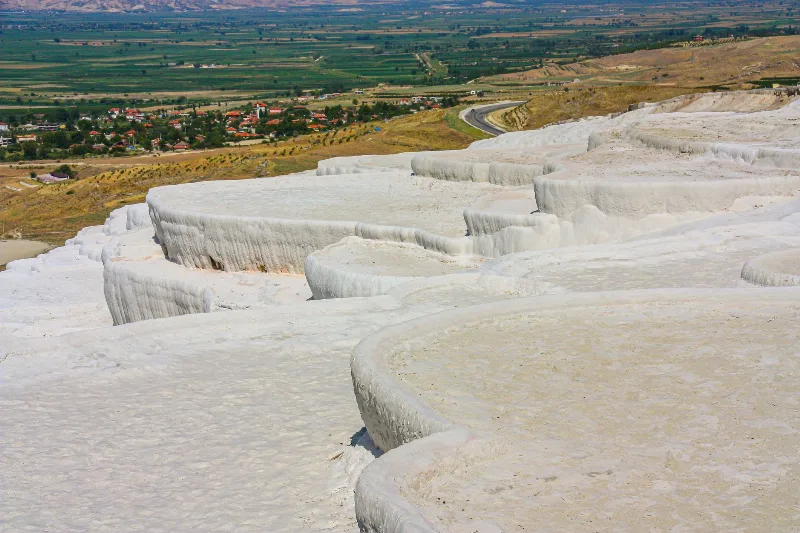
The site stands on a limestone plateau near the modern town of Pamukkale, roughly 20 kilometres from the city of Denizli. It overlooks the Çürüksu Plain, the ancient Lycus valley, which in antiquity contained several notable settlements, including Laodicea on the Lycus and Colossae. To the south, the plateau edge drops away in a series of white terraces created by calcium carbonate precipitating from hot, mineral-rich springs as the water cools and meets the air. The same geothermal system that produced the terraces also supplied the ancient city with its baths, fountains and sacred springs.
Foundation and Historical Background
The name Hierapolis means "holy city" or "sacred city." The settlement is generally dated to the 2nd century BC and is connected with the Attalid kingdom of Pergamon; Eumenes II is often associated with its establishment, though the precise founder and date are not fully settled. From an early stage the city was distinguished by its sanctuaries rather than by political or military prominence. After the Attalid kingdom passed to Rome in 133 BC, Hierapolis entered the Roman orbit and gradually acquired the architecture of a Roman provincial city.
Hierapolis sits in a seismically active region, and earthquakes repeatedly reshaped it. A major earthquake in the mid-1st century AD, in the reign of Nero, caused extensive damage, and the city was subsequently rebuilt with imperial support. Further earthquakes struck in later antiquity. Rebuilding after each event left the city with a layered archaeological record that is useful for understanding how Roman provincial centres recovered and reorganised after natural disasters.
The Sanctuary of Apollo and the Plutonium
The religious core of the city is the sanctuary of Apollo, positioned near a geological fault where carbon dioxide and other gases escape from the ground. Ancient writers described a cave opening here, the Plutonium or Ploutonion, from which a suffocating vapour emerged. This opening was understood in antiquity as an entrance to the underworld, linked to Pluto and Kore, and it served as a place of pilgrimage and ritual. The sanctuary was also connected with the goddess Cybele and with oracular activity. Modern excavation has clarified the layout of the temple of Apollo and the surrounding sacred precinct, but the ancient accounts of the gas and the rituals performed around it should be read as both physical observation and religious interpretation.
The Roman Theatre
The best-known surviving monument at Hierapolis is its theatre, built into the slope of the hillside. It belongs to the Roman imperial period, with a construction phase in the 2nd century AD and later modifications associated with the Severan period in the early 3rd century. The cavea is divided by a diazoma into two tiers of seating, and the stage building behind the orchestra was decorated with a programme of relief sculpture. These reliefs depict mythological scenes involving Apollo and Artemis, and they are among the most important sculptural ensembles to survive from an ancient theatre in Anatolia. Restoration work has been carried out in modern times so that the structure can be read as a theatre rather than as a field of fallen stone.
The Necropolis
Hierapolis has one of the largest and most varied ancient cemeteries in Anatolia, extending for more than a kilometre beyond the city walls. It contains well over a thousand tombs of different types, including simple graves, sarcophagi, chamber tombs and large tumulus mounds. The tombs range across several centuries and reflect a mixed population of Greeks, Romans and later inhabitants. Inscriptions and sculpted decoration on the monuments provide evidence of families, occupations and beliefs. Because the necropolis was placed outside the settlement, it survives as a distinct archaeological landscape rather than as scattered fragments within the built city.
Streets, Baths and Civic Architecture
A long colonnaded main street, commonly identified with the Roman-period street known as Frontinus Street, runs through the centre of the city and links its principal monuments. Along it stood shops, fountains and civic buildings. The most substantial surviving complex is the Roman bath, a large structure that was later converted for other uses. Since the 1980s it has housed the Hierapolis Archaeology Museum, where finds from the city and the surrounding region are displayed. Other remains include an agora, city gates, a nymphaeum and stretches of the defensive walls that were rebuilt in later periods. Much of the civic fabric belongs to the Roman imperial era, while the fortifications and some public buildings reflect the changing conditions of late antiquity.
Christian Hierapolis and the Byzantine Period
According to Christian tradition, the apostle Philip was martyred at Hierapolis, and the city became an important Christian centre in the Byzantine period. A large octagonal structure, the Martyrion of St Philip, was built in the 5th century on a hill outside the main settlement; it is generally interpreted as a pilgrimage church associated with the apostle's cult. The city continued as a bishopric and remained inhabited through the early Byzantine centuries, but earthquakes, shifting trade routes and changing political conditions caused it to decline. By the later medieval period much of the site had been abandoned, and the plateau was largely given over to ruins and to the deposits of the hot springs.
UNESCO World Heritage Status
Hierapolis was inscribed on the UNESCO World Heritage List in 1988 as part of the mixed cultural and natural property that also includes the travertine terraces of Pamukkale. The listing recognises both the archaeological value of the ancient city and the geological significance of the terraces, which are directly linked to the springs that shaped the settlement's history. The designation has supported long-term excavation, conservation and site management.
What Visitors Can See Today
Visitors move through an extensive archaeological area rather than a single monument. The main features that survive to be seen include the theatre with its sculpted stage building, the colonnaded main street, the sanctuary area with the temple of Apollo and the Plutonium, the large necropolis with its range of tomb types, the bath complex that serves as the museum, and the Martyrion of St Philip on the hill above. Sections of walls, gates and fountains are also visible across the plateau. The setting itself is part of the experience: the white travertine terraces lie immediately beside the ancient city, and the archaeological area is entered through the same general landscape as the terraces.
Practical Visiting Context
The site is reached from Denizli, and the surrounding region is served by road and by rail connections to Denizli. Walking through Hierapolis involves uneven stone surfaces, slopes and a considerable distance between the theatre, the sanctuary and the necropolis, so comfortable footwear and time are useful. The terraces and the archaeological area are exposed, with limited shade, and summer conditions in the Lycus valley are hot. Spring and autumn are generally more moderate for walking. The terrain around the travertine pools is wet and slippery in places, and access to some pools is restricted in order to protect the formations. Nearby historical places in the same valley include Laodicea on the Lycus and the site of Colossae, which together with Hierapolis formed part of the dense settlement pattern of the ancient Lycus valley.
Routes
All routes →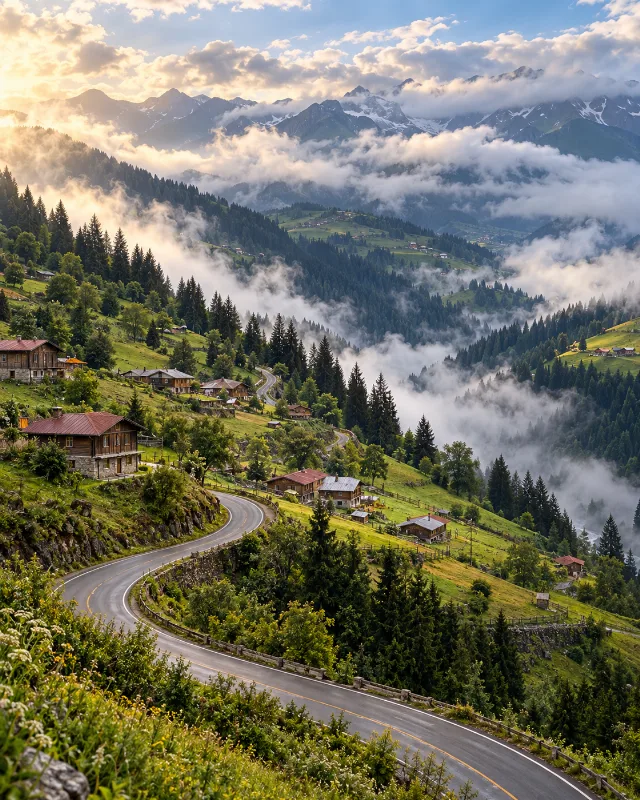
5-Day Eastern Black Sea Route
A five-day journey from Trabzon through Uzungöl, Rize, Çamlıhemşin, Ayder, Borçka and Şavşat, combining Black Sea culture with forests, lakes and highlands.
Explore →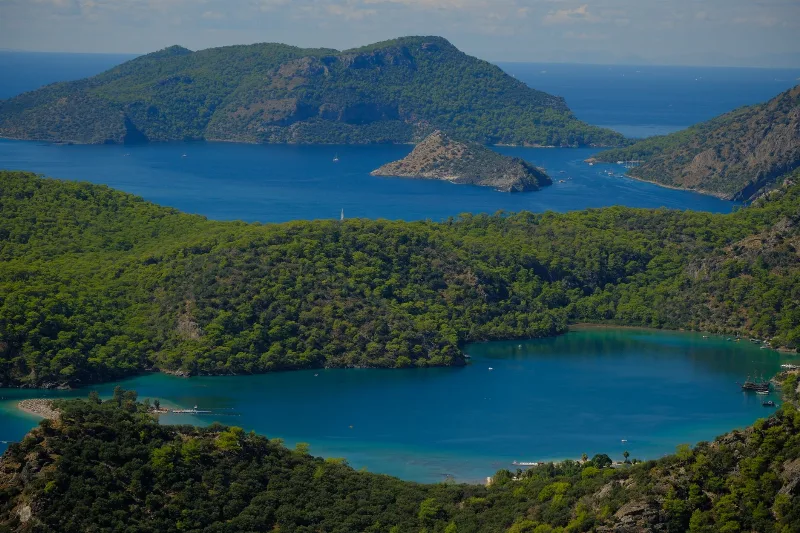
3-Day Fethiye and Ölüdeniz Route
A three-day loop based in Fethiye that combines the Lycian rock tombs and old harbour quarter with the Blue Lagoon at Ölüdeniz, the abandoned village of Kayaköy and the inland gorge at Saklıkent.
Explore →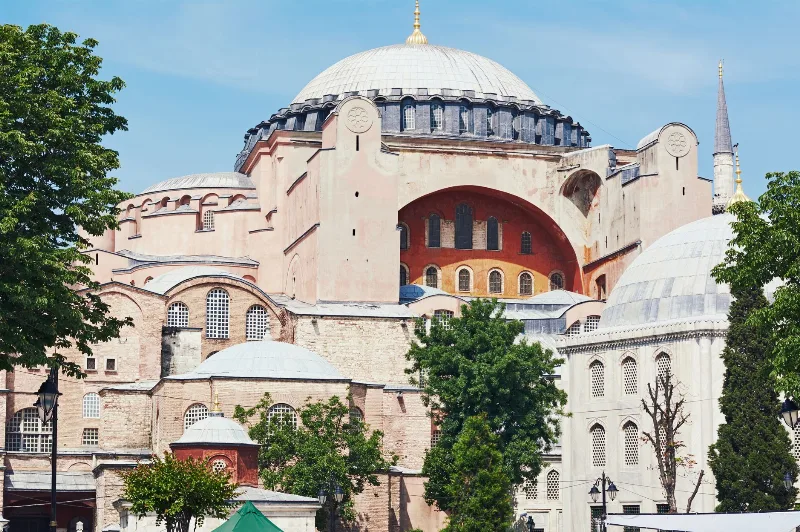
1-Day Istanbul Historic Peninsula Route
Explore Istanbul's Historic Peninsula in one day on foot, visiting Hagia Sophia, the Blue Mosque, Topkapı Palace, and the Grand Bazaar. This compact walking route covers the highlights of Sultanahmet with a logical, easy-to-follow order.
Explore →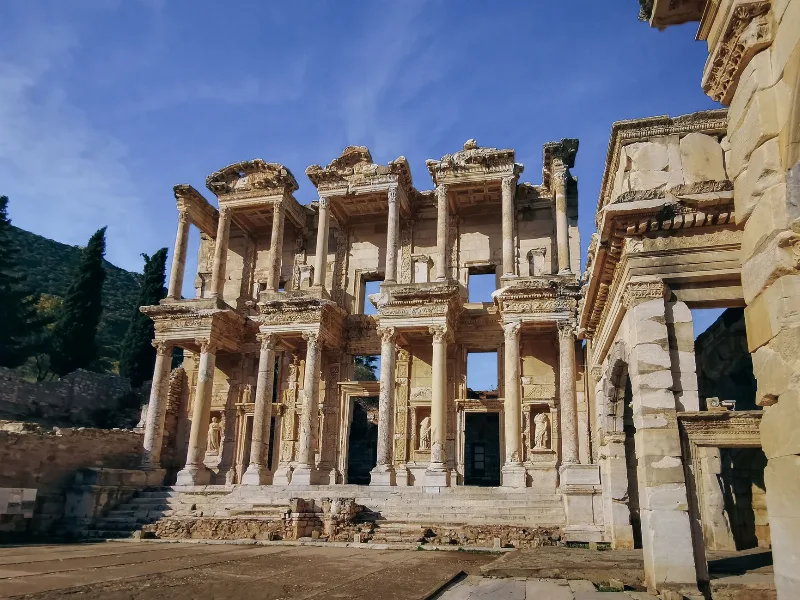
6-Day Aegean Ancient Cities Route
A six-day linear journey from Izmir to Denizli through the great ancient cities of the Aegean, linking Ephesus, Priene, Miletus, Didyma, Lake Bafa, Pamukkale, Laodicea and Aphrodisias in one coherent corridor.
Explore →Related content
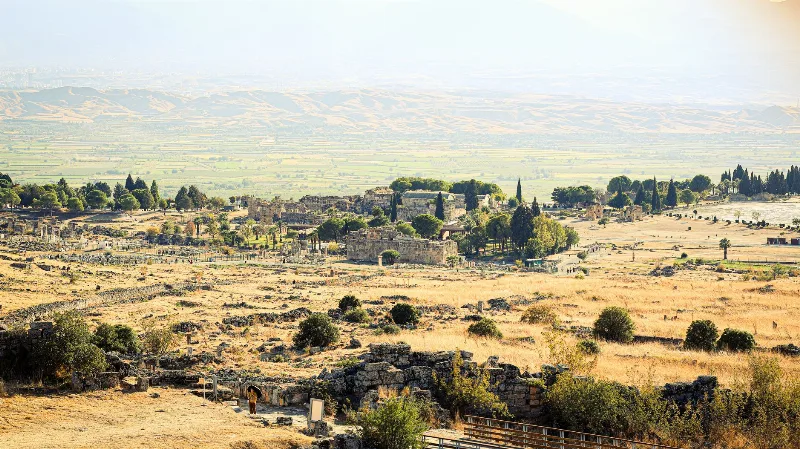
Denizli
Denizli is the inland capital of Denizli Province in Türkiye's Aegean region, known internationally for the Pamukkale travertine terraces and ancient Hierapolis, and at home as a major textile city with its own long-crowing rooster breed.
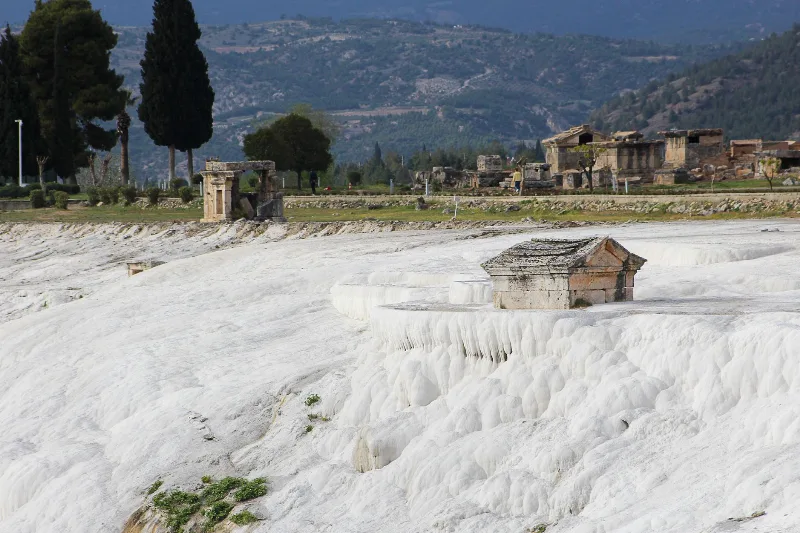
Pamukkale
Pamukkale, Türkiye'nin en etkileyici doğal harikalarından biri olarak bilinir, büyüleyici beyaz termal terasları ve antik Hierapolis kentiyle dikkat çeker.
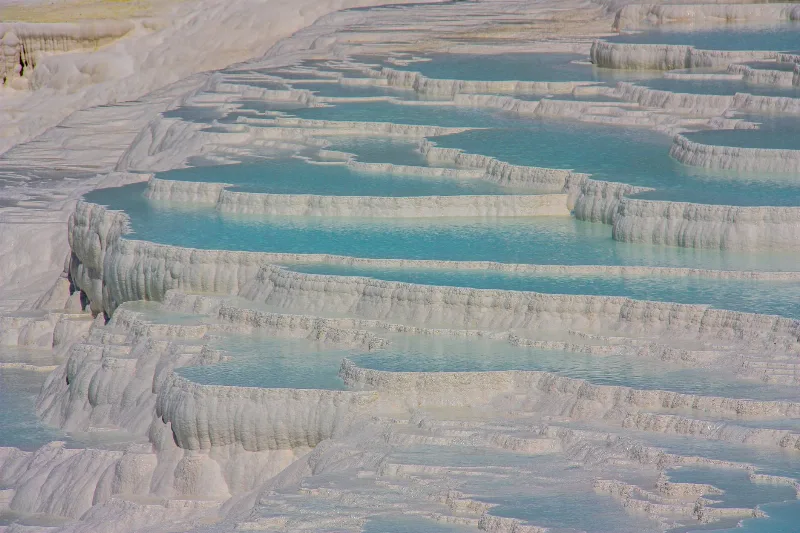
Pamukkale
Pamukkale in Denizli province is a UNESCO World Heritage site where calcium-rich thermal water has built a cliff of white travertine terraces above the ancient city of Hierapolis. Visitors walk barefoot across the terraces, while the plateau above holds Roman baths, a theatre, the Plutonium and one of Anatolia's largest necropolises.
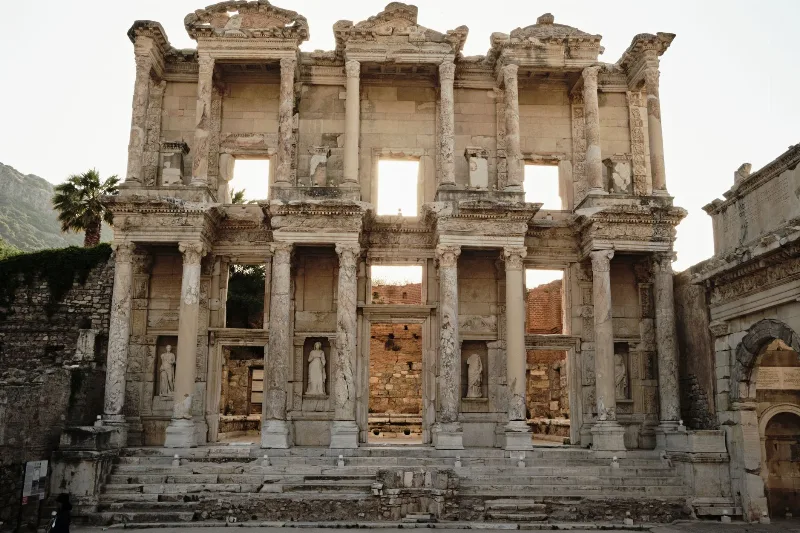
4-Day Ephesus and Pamukkale Route
A four-day west-to-east Aegean route that links the ancient city of Ephesus and the House of Virgin Mary in Selçuk with the white travertine terraces and Hierapolis ruins at Pamukkale, near Denizli.
The Natural Wonders of Pamukkale
Pamukkale in Denizli, Türkiye, is a hillside of white travertine terraces and warm mineral springs that has been shaped by geology for millennia.
Pamukkale
Pamukkale is a white travertine formation in Denizli Province, built up over millennia by calcium-rich thermal springs that flow down the edge of a plateau beside the ancient city of Hierapolis.