
Ishak Pasha Palace
Ishak Pasha Palace is a partly ruined Ottoman palace complex built above Doğubayazıt in eastern Türkiye. Raised between the late 17th and late 18th centuries, it is known for combining Ottoman, Persian, Seljuk and Armenian building and decorative traditions on a terrace facing Mount Ararat.
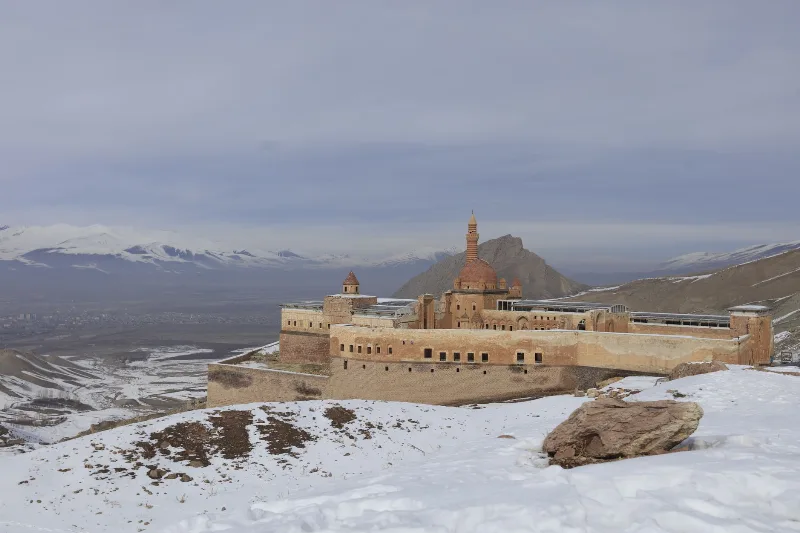
Ishak Pasha Palace (İshak Paşa Sarayı) is a partly ruined Ottoman palace complex standing on a rocky terrace above the town of Doğubayazıt in Ağrı Province, in the far east of Türkiye. Its main construction phase ran from the late 17th century to the late 18th century, and it is notable for bringing Ottoman planning together with Persian, Seljuk, Armenian and Georgian building and decorative traditions in a single walled complex. From the palace terrace the plain below opens toward Mount Ararat (Ağrı Dağı), the highest mountain in the country, which dominates the northern horizon on clear days.
Where the Palace Stands
The palace occupies a terraced platform of dark local stone on the edge of the old settlement known as Eski Bayazıt, a short distance uphill from the modern center of Doğubayazıt. The town lies in the easternmost part of Ağrı Province, close to the border with Iran, on a broad plain at the foot of Mount Ararat. The elevation of the site above the plain explains why it was chosen: it offers both a defensible position and a wide field of view over the town, the surrounding farmland and the mountain to the north. The building is not isolated in open country; it forms part of a small historic cluster that also includes older fortifications and a religious site on the same slope.
Building History
Construction began in the late 17th century, in 1685, under Çolak Abdi Pasha, the Ottoman governor of the Bayazıt frontier region. Work continued under his successors and the complex reached its main form around 1784, during the governorship of İshak Pasha, after whom it is named. Rather than a single palace building, it functioned as a seraglio: a walled seat of local power that combined residence, administration and religious use for the ruling family of the region.
In the following century the area experienced war and upheaval, including the Russo-Turkish War of 1877–78, and the palace lost its administrative role. It was gradually abandoned, parts of its stone were reused locally, and it fell into ruin before modern restoration work began. The site was placed on the UNESCO World Heritage Tentative List in 2000, which reflects its architectural value rather than a fully intact condition — visitors should expect a partly ruined complex rather than a restored, furnished palace.
Architecture and Design
The palace is most often described as an architectural blend, and the mix is visible in the fabric of the walls rather than only in decoration. Ottoman features include the courtyard-based plan and the domed mosque inside the complex. Seljuk influence appears in the carved stone portal, a crown gate framed with muqarnas, the stepped geometric vaulting typical of Anatolian Seljuk buildings. Armenian stone-carving traditions are reflected in the relief work and in the careful masonry of some sections, while Persian and broader eastern influences can be read in the layout and in the ornamental detail of the interiors. The overall result is an eclectic building that does not fit neatly into a single style.
Local volcanic stone, dark and fine-grained, is the main material, which gives the walls their heavy, uniform tone. The complex is organized around courtyards, with different wings serving different purposes. Accounts of the building frequently mention an underfloor heating arrangement fed by channels beneath the floors, a feature suited to the harsh winters of this high plateau. Windows and doors are positioned to make the most of the light and the view across the plain.
What You Can See Inside the Complex
Several distinct parts of the palace survive or have been consolidated, and they give a clear sense of how the complex worked:
- The crown gate and outer walls: the carved entrance portal is the most photographed element, and the surrounding defensive walls show the semi-fortified character of the site.
- The mosque: a small domed mosque stands within the complex, with a slender minaret; it is the clearest example of the Ottoman strand in the design.
- The mausoleum: a domed tomb building holds the burial of İshak Pasha, tying the monument directly to the man whose name it carries.
- The courtyard and audience areas: open courts and halls that once served for reception, administration and daily life of the household.
- The harem and service rooms: residential and working quarters, including kitchen and storage spaces, now largely empty but readable in plan.
- Dungeons and cells: smaller vaulted chambers in one section that are usually interpreted as holding or service rooms.
Because the interiors are unfurnished and partly roofless in places, the experience is architectural and archaeological rather than museum-like. Much of the interest lies in the stonework, the vaulting and the sequence of spaces.
The Surrounding Landscape and Mount Ararat
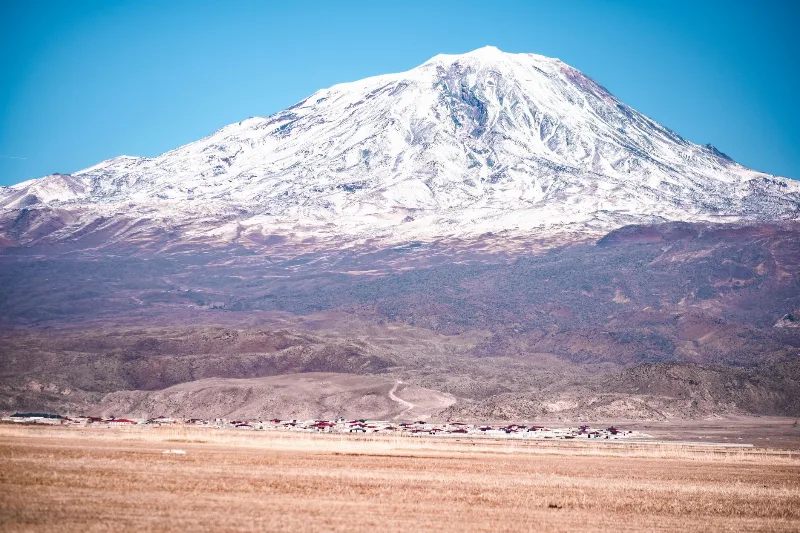
The setting is a major part of the site's character. The palace looks north across the Doğubayazıt plain toward Mount Ararat, a large stratovolcano whose snow-covered summit is visible in good weather for much of the year. To the east, the land rises toward the Iranian border, and the plain is a patchwork of fields and small settlements. The climate of the plateau is continental: hot, dry summers and long, very cold winters with heavy snow. This contrast shapes both the vegetation — largely steppe and sparse trees — and the visiting season. The darkness of the palace stone against the pale plain and the white mountain is one of the most distinctive views in this part of Türkiye.
Getting There and Visiting Basics
Doğubayazıt is reached by road and by air through two regional airports: Ağrı Ahmed-i Hani Airport, which is closer, and Van Ferit Melen Airport, which is further but served by more flights. From either airport the journey continues by road, generally by car, taxi or bus. The town sits on a main east–west highway, so it is accessible from central and eastern Anatolia, though distances here are long and travel times should not be underestimated.
The palace itself is a short drive uphill from the center of Doğubayazıt. There is no practical way to walk there from the town center along a safe, continuous pedestrian route, so a car or taxi is normally used, and parking is available near the entrance. The site operates as a ticketed heritage site managed by the national culture and tourism authorities. Opening hours and entrance fees change over time and by season, so it is sensible to confirm current details locally on the day of the visit. Facilities on the spot are limited; there are no shops or cafés inside the complex, so visitors should bring water, especially in summer.
Weather and the Best Time to Visit
The most comfortable months are from late spring to early autumn, roughly May to September, when the roads are clear and the terrace is dry underfoot. July and August are the hottest, with strong sun and little shade on the exposed platform, so early morning or late afternoon visits are easier. Spring and autumn bring milder temperatures and clearer light, though rain and wind are possible. Winter is severe: Doğubayazıt is among the coldest places in the country in that season, with deep snow and sub-zero temperatures, and access to the terrace can be difficult or restricted. Snow on the plain can produce striking photographs of the palace against Mount Ararat, but travel plans should be flexible.
Terrain, Walking and Accessibility
The site is built on several levels, connected by stone stairs, slopes and uneven paving. Walking shoes with grip are more suitable than smooth-soled footwear, and the surfaces can be slippery after rain or snow. There are no lifts or ramps for every section, and visitors with limited mobility will find parts of the complex difficult to reach; the main courtyard and gate area are the most accessible parts. The walk across the complex is short in distance but involves constant small changes in level. Visitors should also note that the site is close to a border region, where identity checks can occur on roads in the area.
Nearby Places Worth Combining with a Visit
Several sites lie within a short distance and are naturally visited together with the palace. The tomb of Ahmed-i Hani, a respected religious and literary figure of the region, stands on the slope below the palace and is a place of local pilgrimage. The ruins of the old Bayazıt fortress, associated with the earlier settlement of Eski Bayazıt, occupy higher ground nearby. The town of Doğubayazıt itself provides the practical base for a visit. Further afield, the wider region includes Mount Ararat, the city of Van with its lake and historic sites, and the landscapes of eastern Anatolia toward Kars. Because these destinations sit along long regional routes, a visit to Ishak Pasha Palace is usually part of a wider journey through eastern Türkiye rather than a standalone stop.
Related content
Mount Ararat
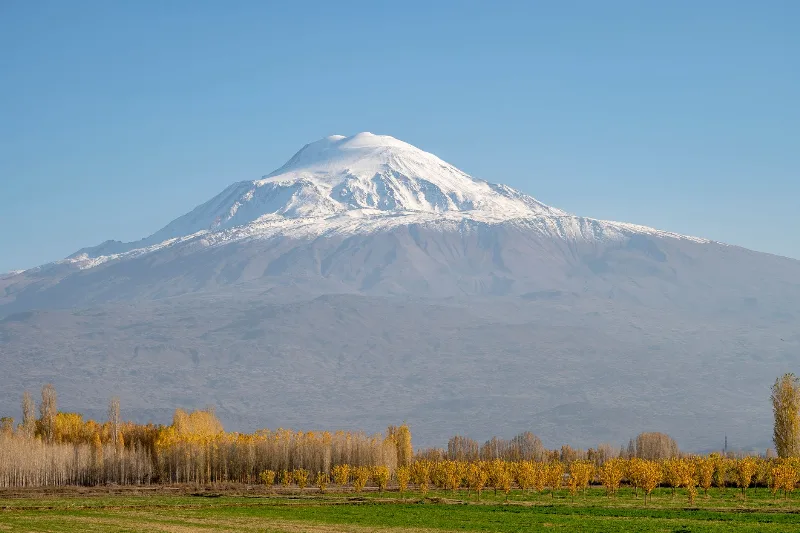
Mount Ararat (Ağrı Dağı) is a dormant, snow-capped stratovolcano in eastern Turkey and the country's highest mountain, rising in two distinct cones above the Iğdır Plain near the Iranian border.
Mount Ararat
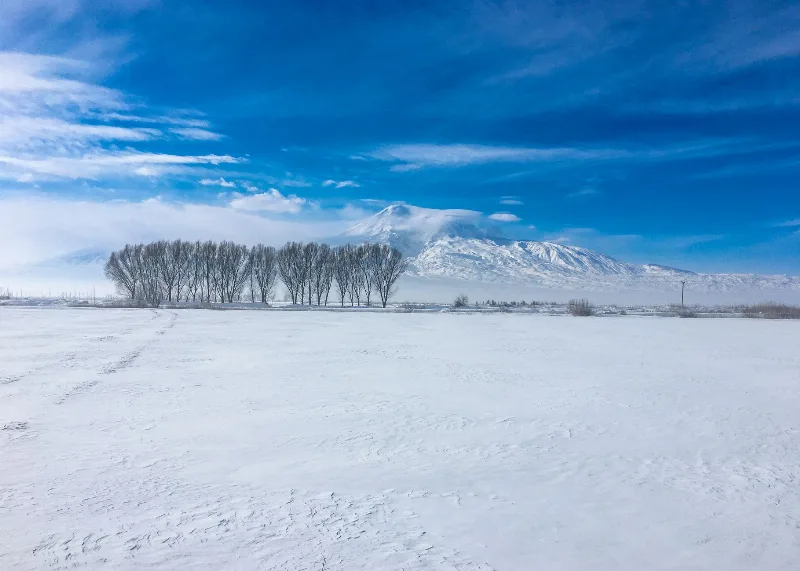
Mount Ararat is a dormant stratovolcano in eastern Türkiye and the country's highest mountain at 5,137 metres, known for its twin peaks, permanent ice cap and the long-standing Noah's Ark tradition.
Ağrı
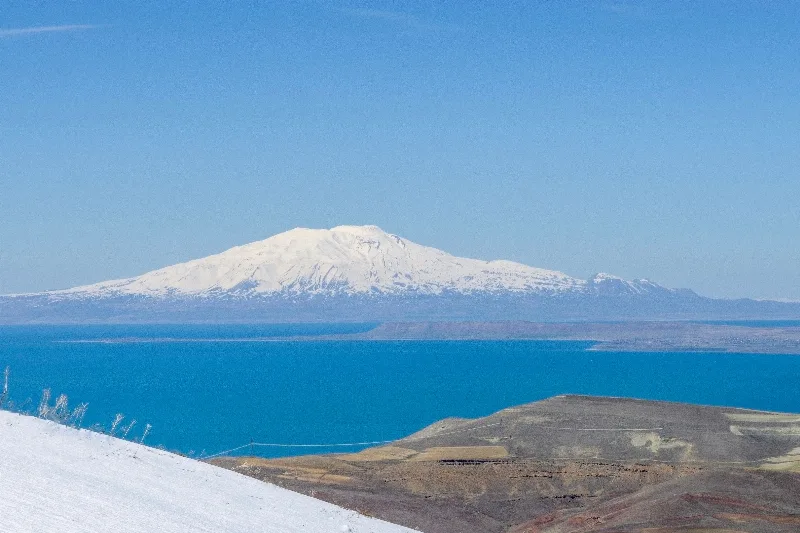
Explore Ağrı, eastern Türkiye: history, standout sights, landscapes, local food and practical travel advice for an unforgettable journey in Türkiye.
Ishak Pasha Palace
Ishak Pasha Palace is a late Ottoman palace complex in Doğubayazıt, Ağrı Province, eastern Turkey. Built between the late 17th and late 18th centuries, it is known for its stone architecture, which combines Ottoman, Seljuk, and Persian elements.
Mount Ararat Adventures
Mount Ararat, or Ağrı Dağı, is Türkiye's highest mountain, a snow-capped volcano in the far east that draws hikers with its high camps, wide plains and layers of legend.
Eastern Anatolia Region
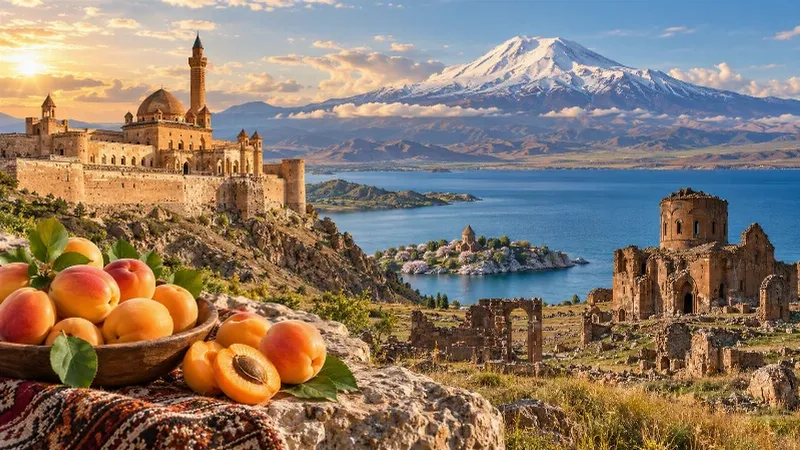
Eastern Anatolia is a region of majestic mountains, vast highlands, beautiful lakes and ancient cultural heritage. Home to Mount Ararat, Lake Van and historic settlements, it offers some of Türkiye's most dramatic natural landscapes alongside distinctive architecture, local traditions and regional cuisine.