
Sümela Monastery
Sümela Monastery is a Greek Orthodox complex cut into a vertical rock face in the Pontic Mountains of Trabzon Province, Türkiye. Its clifftop setting, 4th-century origins and painted rock church make it one of the most distinctive religious monuments in the Black Sea region.
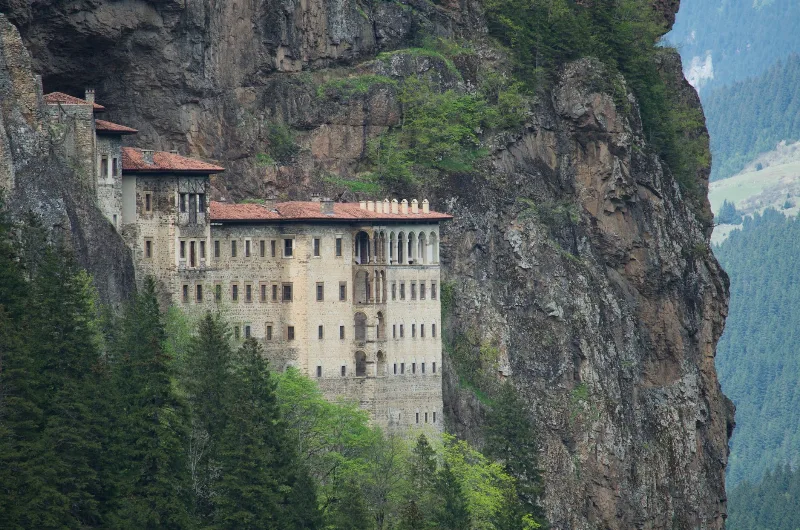
Sümela Monastery is a Greek Orthodox monastery built into a near-vertical rock face above the Altındere Valley in the Pontic Mountains of north-eastern Türkiye. It lies in the Maçka district of Trabzon Province, roughly 50 kilometres south of the city of Trabzon, and is dedicated to the Virgin Mary, called Panagia in Greek. The complex clings to the cliff at a considerable height above the valley floor, so that approaching visitors see its walls, arches and rooftops stacked against the stone long before they reach it. Because of that setting, its Byzantine origins and the painted rock church at its core, Sümela is treated as one of the defining monuments of the Black Sea region and has been on Türkiye's tentative list for UNESCO World Heritage status.
Where the Monastery Stands
The monastery occupies a natural cave and the ledges around it on the western flank of Karadağ, the "Black Mountain", inside Altındere Valley National Park. The valley below carries the Altındere stream through dense forest of pine, fir, beech and hornbeam, and the monastery sits well above the tree line of the lower slopes. The site is high enough that snow lingers late into spring, and the combination of steep rock, forested valley and a building suspended above it is what gives Sümela its identity. The name itself is usually explained as a contraction of "Panagia tou Melas", referring to the dark mountain on which it was built.
Origins and Historical Context
According to tradition, the monastery was founded in 386 AD during the reign of the Byzantine emperor Theodosius I, by two monks, Barnabas and Sophronios, who are said to have come from Athens. The foundation was dedicated to the Virgin Mary, and the community preserved an icon of the Panagia that tradition links to the evangelist Luke. Whatever the precise origins, the site developed into a major monastic centre of the Pontic Greek world over the following centuries.
The monastery's fortunes rose sharply in the medieval period, when it received support from the rulers of the Empire of Trebizond. It was expanded and endowed, and its reputation spread well beyond the Pontic mountains. After the Ottoman conquest of Trebizond in 1461, the monastery continued to function, and successive sultans issued decrees confirming its rights and privileges — an arrangement that allowed the community to survive for centuries under changing political rule. Further building and repainting took place in later centuries, particularly in the 18th and 19th centuries, when much of the monastery's present fabric and decoration was renewed.
The monastery was abandoned in 1923, when the population exchange between Greece and Türkiye ended the Greek Orthodox community of the region. It then stood empty and exposed for decades, suffering from weathering, vandalism and the instability of the rock above it.
What There Is to See
The heart of the complex is the rock church, carved into the cave itself and its walls covered with frescoes. These paintings depict scenes from the life of Christ and the Virgin Mary, along with saints and other figures, and although they have suffered damage over time, the colour and detail that survive give a clear sense of the monastery's former richness.
Around the church are the other elements of the monastic layout: chapels, a kitchen, cells and rooms for monks and students, and a library. Water reached the monastery through a system of aqueduct arches built along the slope, some of which remain visible. The outer buildings, with their arched facades and long balconies, frame a small courtyard from which the church and the cliff above are best seen. A narrow stone stairway climbs the rock face to a small chapel high above the main level, and it is one of the most photographed features of the site.
The Valley Setting and Physical Character
Sümela is as much a landscape monument as an architectural one. The cliff is steep and fractured, and rockfall has long been a concern; engineering work to stabilise and protect the site has formed part of its recent history. Below, the Altındere Valley National Park protects a large area of forest and mountain habitat, and the road and paths to the monastery pass through this scenery. The approach gives a clear view of how the building was positioned: sheltered by the overhang of the cave, facing the valley, and almost invisible until the visitor is close to it.
Getting There and the Walk Up
Most visitors travel from Trabzon to Maçka and then on to Altındere village, from which a road leads to the monastery's parking and entrance area. From that point the final approach is on foot, climbing through the forest on a path with steps. The ascent is steep in places and involves several hundred metres of climbing, so it takes real effort, especially in warm weather. There is an admission fee, and opening times vary through the year and can change at short notice, so it is worth checking current conditions before setting out.
Accessibility and Terrain
The monastery is not a flat, easily navigated site. The approach path is uphill, and inside the complex there are steps, narrow passages, uneven stone floors and low doorways. Visitors with limited mobility, heart or breathing conditions, or small children should plan accordingly, and the stairs to the upper chapel are steep and not suitable for everyone. Sturdy footwear is more useful here than ordinary city shoes.
Seasons and Conditions
Late spring through early autumn is generally the most straightforward period to visit, when the paths are clear and the valley is green. Summer brings the largest crowds and the hottest climbing conditions, so early morning is the most comfortable time. Winter and early spring can bring heavy snow and ice to the mountain, and access may be restricted when conditions are unsafe. Even in the warmer months, mountain weather can change quickly, and mist or rain can reduce visibility along the valley.
Practical Points to Keep in Mind
- The site is an active heritage monument, not a theme park; visitors are expected to respect the church and the remaining paintings.
- Photography inside the rock church can be restricted or discouraged, so it is worth checking on site.
- Facilities at the monastery itself are limited; the main services are in Altındere village and Maçka.
- The climb, the altitude and the weather all make water, a layer of warm clothing and a light rain jacket sensible precautions.
- Because the monastery has been closed at times for restoration and rockfall protection, confirm that it is open before making the journey.
Other Monasteries and Places Nearby
The mountains around Maçka hold the remains of other Pontic monasteries, including Vazelon and Kuştul, which share the region's monastic history but survive only as ruins. Altındere Valley National Park itself offers forest walks and picnic areas below the monastery. Travelling back towards the coast, the city of Trabzon has the Hagia Sophia of Trabzon, the Atatürk Mansion and the Boztepe viewpoint, while further south the Zigana mountains and the Uzungöl area continue the highland character of the province. Together these places make the Maçka and Altındere area one of the most historically layered parts of the Turkish Black Sea coast.
Related content
Trabzon
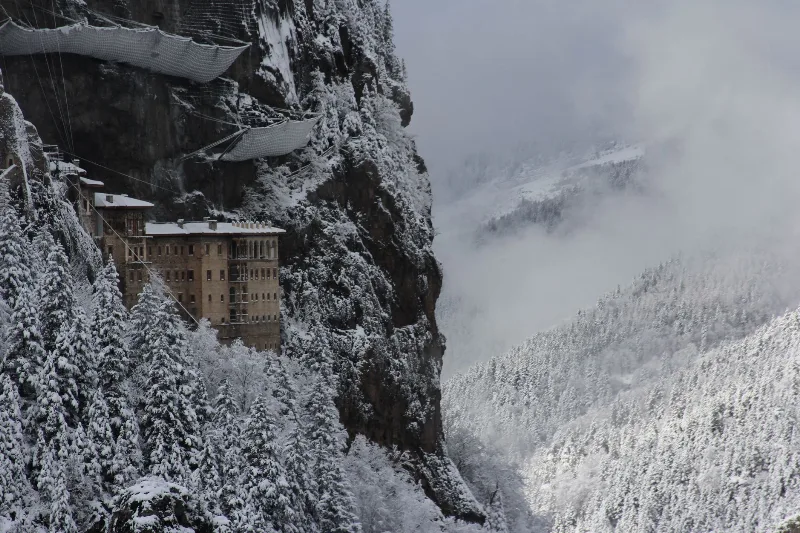
Trabzon is a rain-washed port city on Türkiye's eastern Black Sea coast, framed by the cliffside Sumela Monastery and slopes of tea. Byzantine and Ottoman layers sit close to highland valleys just inland.
Hagia Sophia
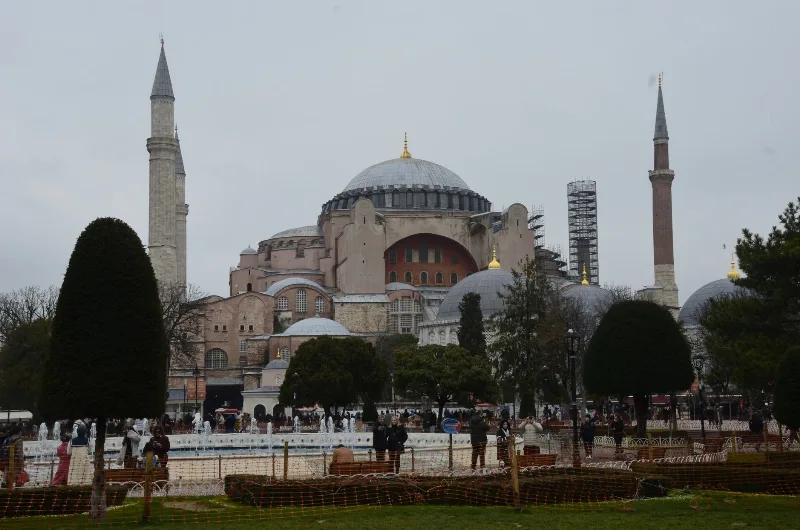
Hagia Sophia in Istanbul is a monumental religious building begun under the Byzantine emperor Justinian I in 537 CE, later converted into an Ottoman mosque and today serving again as a mosque and UNESCO-listed monument.
Uzungöl
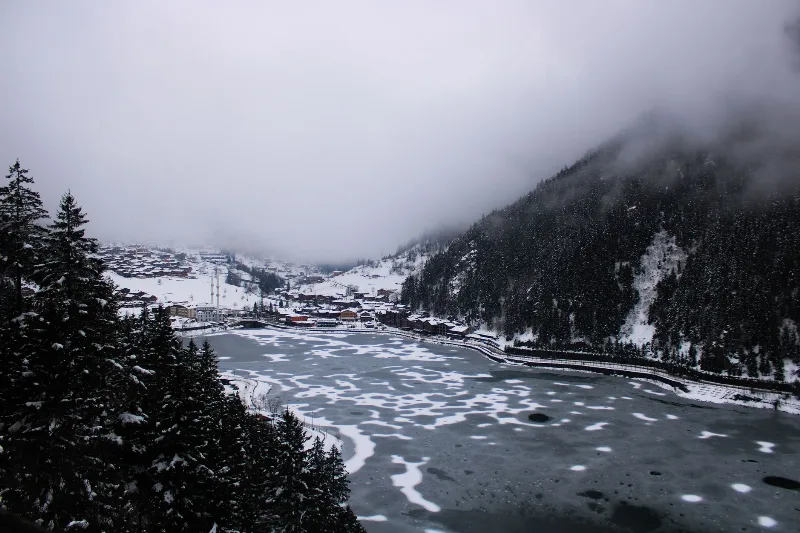
Uzungöl is a highland village in Trabzon's Çaykara district, wrapped around a dark mountain lake held back by a landslide dam and surrounded by dense Black Sea forest.
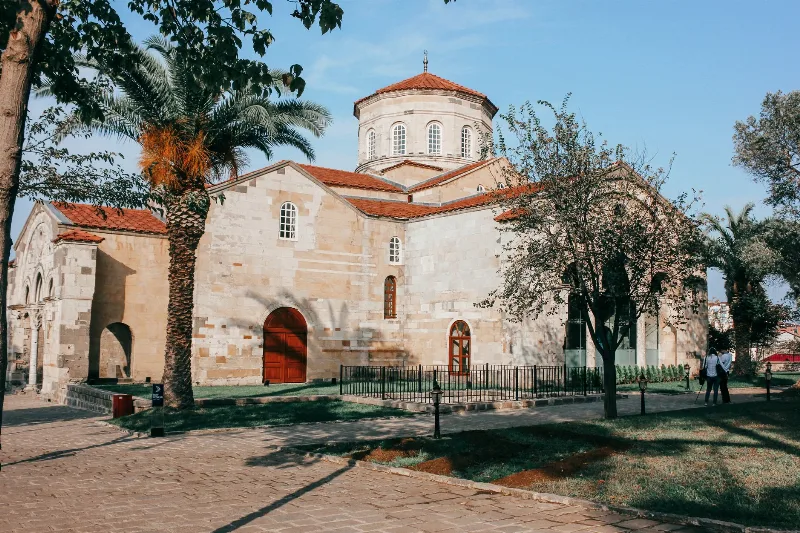
3-Day Trabzon and Uzungöl Route
This 3-day route in Türkiye's Eastern Black Sea region starts and ends in Trabzon, visiting Hagia Sophia, Sümela Monastery, and Uzungöl Lake. It blends city sightseeing, mountain driving, and lakeside relaxation.
7-Day Eastern Black Sea Highlands Route: Trabzon to Artvin
A seven-day driving route through the Eastern Black Sea highlands, from Trabzon and Sumela to Uzungöl, Ayder, the Kaçkar Mountains and the forests of Şavşat, ending at Artvin.
6-Day Central Black Sea Route
A six-day journey along Turkey's Central Black Sea coast from Samsun to Trabzon, visiting Ordu and Giresun with highland and beach stops.