
Side
Side is an ancient Greek harbour city on Türkiye's Mediterranean coast, known for the Temple of Apollo, a large Roman theatre and streets of ruins that visitors can still walk through. Its remains sit inside a modern town in the Manavgat district of Antalya Province.
Side is an ancient Greek city on the Mediterranean coast of Türkiye, occupying a small peninsula in the Manavgat district of Antalya Province, roughly 75 kilometres east of the city of Antalya and about 5 kilometres from the town of Manavgat. Its ruins are not fenced off from daily life: columns, paved streets, city walls and a theatre stand among the houses and gardens of the modern settlement that carries the same name. Side was one of the principal harbours of Pamphylia, the coastal plain between the Taurus Mountains and the sea, and it grew wealthy as a port through the Hellenistic and Roman periods before silting, earthquakes and raids ended its life as a city.
A Greek Colony on the Pamphylian Coast
The name Side is generally traced to an Anatolian word for pomegranate. Ancient tradition and the city's own coinage link its foundation to settlers from Kyme in Aeolis, on the western coast of Anatolia, who arrived in the 7th century BC. The new colony took a natural harbour on a low peninsula, a position that gave it sheltered anchorage, fresh water and defensible ground in a region already occupied by older Pamphylian settlements.
Side passed under Lydian and then Persian control before Alexander the Great reached it in 334 BC. After his death the city shifted between the Ptolemaic and Seleucid kingdoms, then came under the Attalids of Pergamon and, by the first century BC, under Rome. Roman rule brought a long period of building and trade, and the monuments that survive today are largely the product of that era. In late antiquity Side became a bishopric, and the remains of a Byzantine basilica stand near the harbour where the Christian community once gathered.
The Temple of Apollo and the Harbour Front
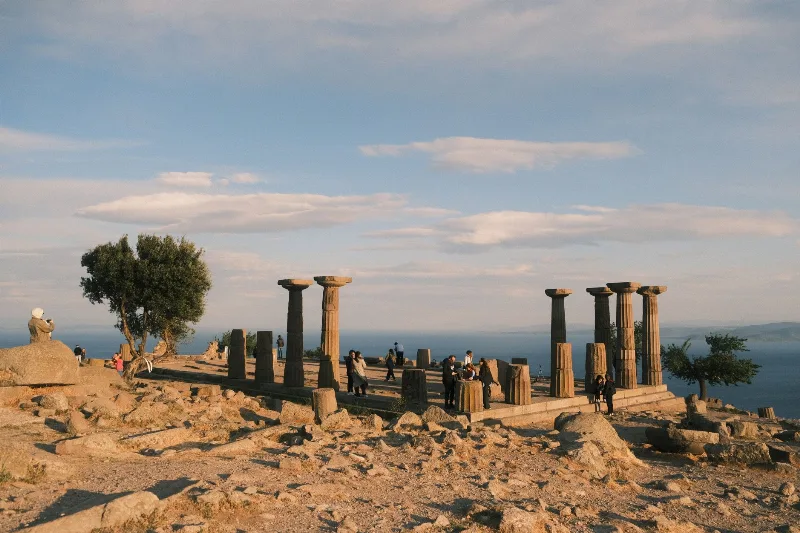
The Temple of Apollo is the image most people associate with Side. It stands at the seaward end of the peninsula, close to the shore, and is usually dated to the 2nd century AD. It was built in the Corinthian order on a peripteral plan, with a colonnade running around the cella, and was dedicated to Apollo, a god worshipped here alongside Athena, who had a smaller temple beside it.
Only a portion of the structure survives, and the columns standing today were re-erected during modern restoration work rather than preserved upright through the centuries. Even so, the position is what makes the temple memorable: white marble against the water, with the sea on both sides of the headland. Nearby, the outline of the ancient harbour is still legible, though the bay that made Side a trading port has long since silted up.
The Theatre and the Colonnaded Street
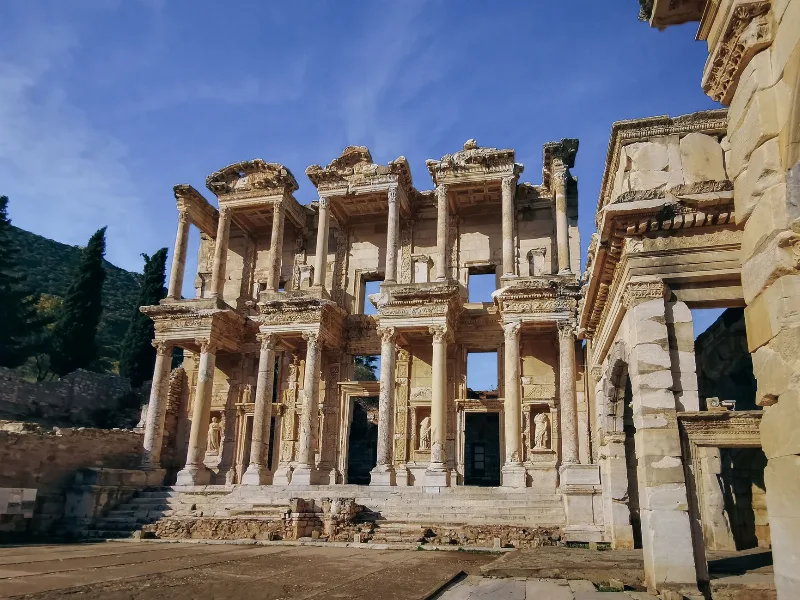
The Roman theatre is the largest structure on the site and one of the biggest in the region, with seating estimated at around 15,000. It was rebuilt in the 2nd century AD over Hellenistic foundations, and its cavea rests on a substructure of vaulted galleries rather than on a natural hillside. The upper seating was divided by a walkway, and the stage building that once framed the performances has largely collapsed. The theatre has been restored and is used for concerts and festivals in summer.
Leading back from the theatre towards the harbour is the main colonnaded street, a broad avenue once lined with shops and porticoes. Fallen column drums and bases still mark its course. At the theatre end of the street stands a monumental fountain, or nymphaeum, built in the 2nd century AD and originally several storeys high, with water delivered into basins at street level.
Baths, Gates and the Water Supply
Side's Roman bathhouse, built in the 5th century AD, is one of the best-preserved buildings in the city and now houses the site museum. Its vaulted halls give a clear sense of how a late antique bath complex was organised. Inside, the collection includes statues, reliefs, inscriptions, altar pieces and sarcophagi recovered from the city and its surroundings.
The landward side of Side is defined by its defensive walls and gates. The main gate, known as the Great Gate, is a Hellenistic structure of the 2nd century BC, and a second monument, the Vespasian Gate, carries a dedication to the emperor Vespasian. Outside the walls, a Roman aqueduct carried water to the city from springs inland, and stretches of its arches can still be traced in the surrounding countryside.
The Necropolis and the City of the Dead
East of the inhabited area lies an extensive necropolis, one of the more atmospheric parts of Side and one that many short visits miss. It contains temple tombs, chamber tombs and sarcophagi, some with carved garlands and inscribed panels. Because the burial ground was outside the walls, walking through it gives a sense of the city's original extent, which was considerably larger than the compact peninsula core.
Landscape and Physical Character
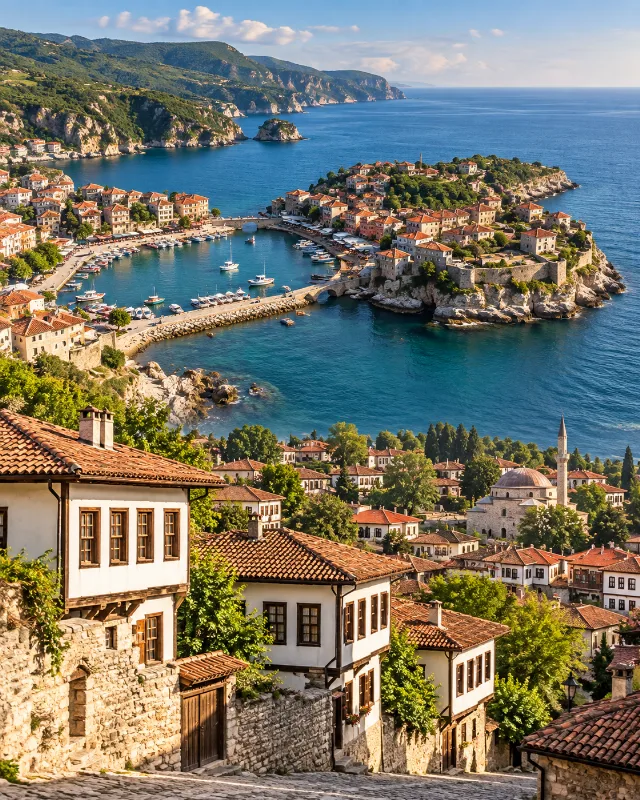
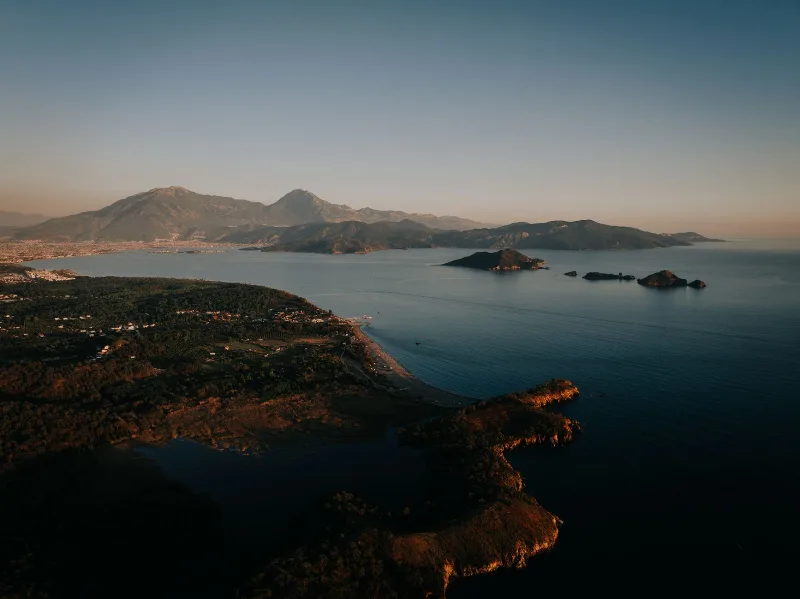
Side sits on a flat peninsula of modest height, roughly a few hundred metres across, with sandy shoreline on both its Mediterranean and lagoon sides. There is no dramatic cliff or mountain backdrop; the interest lies in the density of the remains and the way the sea frames them. The soil is sandy and the ground largely level, so the ruins read as a continuous archaeological landscape rather than isolated monuments scattered across hills. Because the modern town grew over the ancient one, excavation has been partial, and some streets and foundations remain beneath buildings and gardens.
Practical Access and Visiting Information
Side is reached by road from Antalya, a drive of around an hour along the coastal highway, or from Manavgat in about fifteen minutes. Intercity buses run to Manavgat and local minibuses connect the town to Side throughout the day. The nearest major airport is Antalya, with Gazipaşa-Alanya further east as an alternative.
The archaeological areas are visitable as a combined zone, with a ticket giving access to the main monuments as well as the museum in the bathhouse. Opening times and ticket arrangements change with the season and with restoration work, so it is worth confirming locally on the day. The site is open-air and almost entirely without shade, and there are few explanatory panels in some sections.
Season, Weather and Timing
Side has a Mediterranean climate: long, hot and humid summers, mild winters with occasional rain, and a spring that brings flowering scrub and green ground cover. July and August are the hardest months for walking ruins, with strong midday sun and little shade. April, May, June, September and October offer more comfortable temperatures and better light for seeing the carved detail on the tombs and temple fragments.
Early morning and the last two hours before sunset are the most workable times in high summer, when the stone has cooled and the light falls at an angle across the columns. Winter visits are quiet but can be interrupted by rain, and some seasonal facilities close.
Walking, Terrain and Accessibility
The peninsula is small enough to cover on foot in a few hours, and most of the monuments are within easy reach of one another. Surfaces are uneven, however: original paving stones, loose gravel, thresholds and steps appear without warning, and the theatre requires climbing steep, worn seating rows. Sturdy shoes are more useful than sandals. The temple area and the colonnaded street are relatively level, but the necropolis and the wall circuits involve rough ground. Visitors with limited mobility can see the Temple of Apollo and the harbour area without difficulty, while the theatre and upper terraces are considerably harder.
Places to Combine with a Visit to Side
Side sits in a stretch of coast rich in ancient sites. Aspendos, with its exceptionally complete Roman theatre, lies to the west near Serik, and Perge, further towards Antalya, preserves a theatre, stadium and colonnaded streets. Inland, the ruined city of Selge climbs a slope in the Taurus foothills, and the smaller sites of Lyrbe and Sillyon stand in the surrounding hills. The Manavgat River and its waterfall are close by, and the Köprülü Canyon National Park offers a very different landscape of gorge and forest for anyone wanting to break up a sequence of ruins.
Related content
Antalya
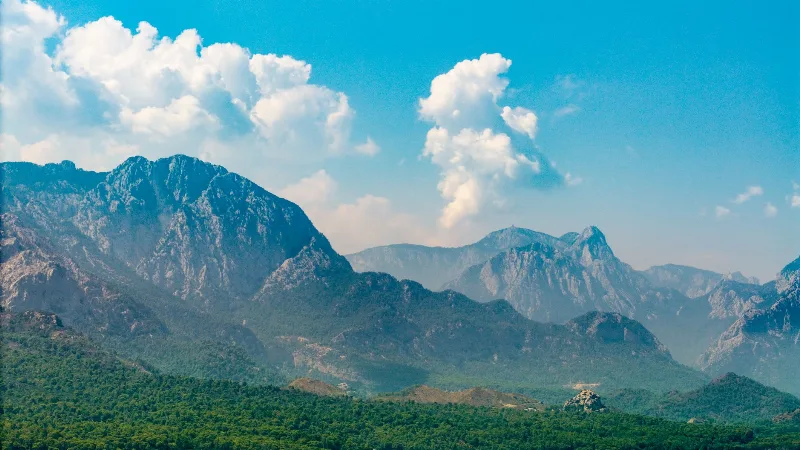
Antalya offers a unique blend of vibrant history and stunning natural beauty, making it a must-visit destination in Türkiye.
Pergamon
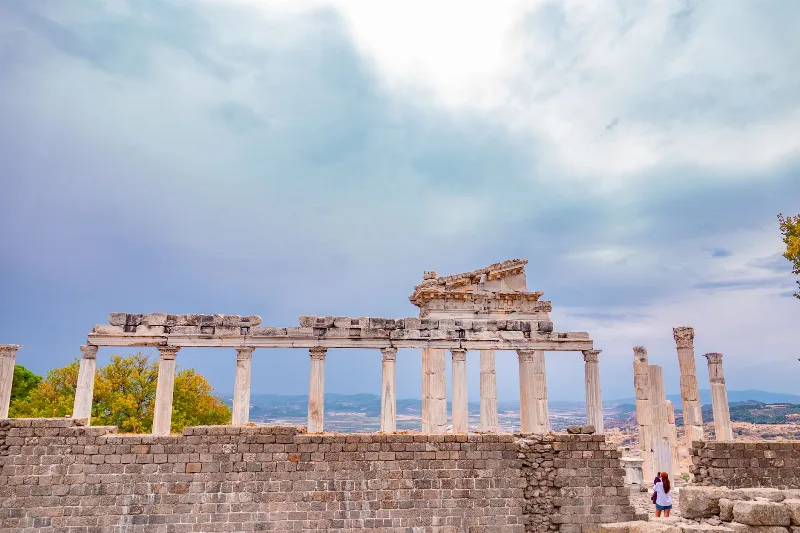
Pergamon was the Hellenistic capital of the Attalid dynasty in western Türkiye, built around a steep acropolis above the modern town of Bergama. Its Great Altar, theatre and Sanctuary of Asclepius make it one of the most important archaeological sites in Anatolia and a UNESCO World Heritage Site.
Pergamon
Pergamon is an ancient Greek city in Aeolis, today the modern town of Bergama in İzmir Province, Türkiye. Its acropolis, library and Great Altar of Zeus, together with the Asclepion healing sanctuary, form one of the most important archaeological settings in the eastern Mediterranean.
Bergama and the Acropolis of Pergamon
Bergama in İzmir Province is the modern town beneath ancient Pergamon, where a hilltop acropolis, a healing sanctuary and a Roman basilica reveal centuries of Anatolian history.
The Ancient City of Pergamon and Its Acropolis
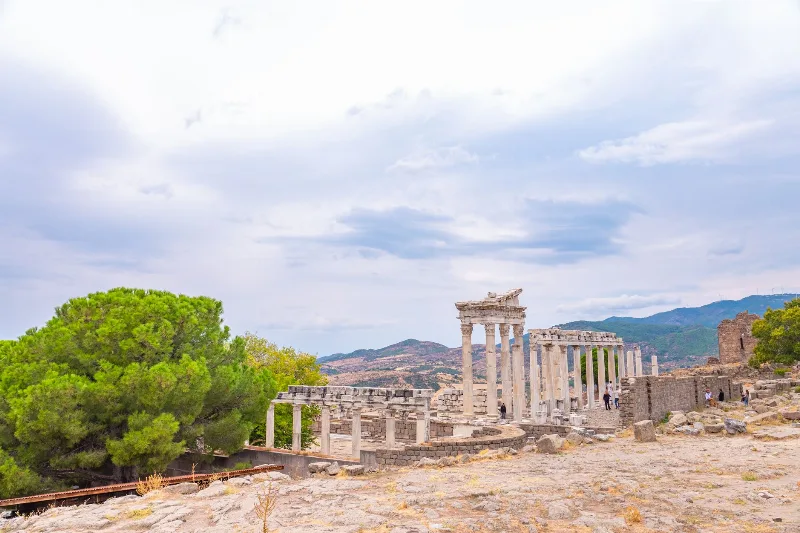
Pergamon, now Bergama in Türkiye, is a UNESCO World Heritage Site with a dramatic acropolis, a Hellenistic theater, and a library that once rivaled Alexandria. Its ruins offer a deep dive into ancient history and culture.
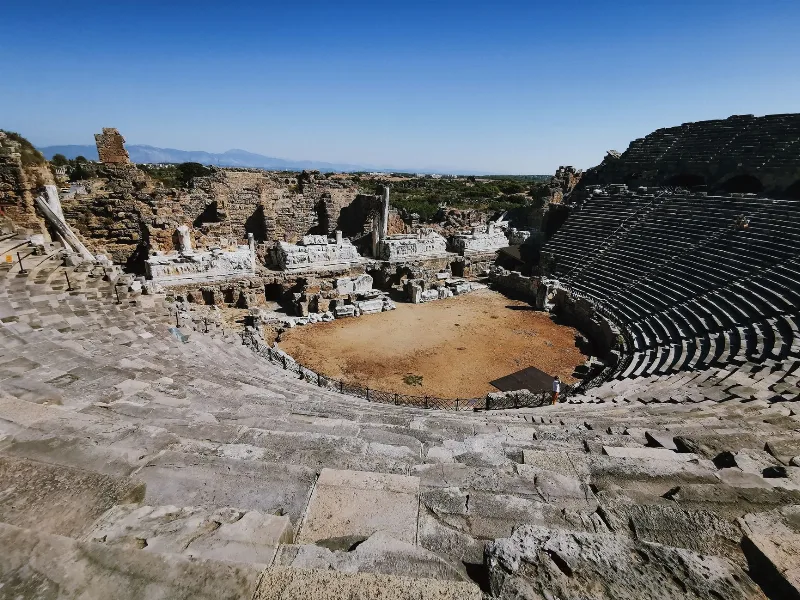
Side
Side is an ancient Pamphylian port city on a peninsula in Antalya Province, Türkiye, known for its well-preserved Roman theatre, the temples of Apollo and Athena, and a museum housed in Roman baths. It flourished under Hellenistic and Roman rule and was abandoned by the 10th century, leaving extensive ruins that visitors can explore today.