
Beypazarı
Beypazarı is a district town in Ankara Province where a large stock of Ottoman-era houses still lines the old streets, and where mineral water springs, silver filigree work and carrot growing shape daily life. It is an easy inland counterpart to the better-known historic towns of Anatolia.
Beypazarı is a district town in Ankara Province, roughly 100 km west of the capital, spread across the floor and lower slopes of a valley beneath dry, eroded hills. It is one of the few places in Central Anatolia where a substantial number of Ottoman-period town houses survive in their original street pattern, and the old quarter is still inhabited rather than preserved as an open-air museum. The town is equally known for its mineral water springs, for silver filigree and copper work, for hand-printed headscarves, and for the carrot fields that cover the surrounding valley floor.
Where Beypazarı sits in Ankara Province
Beypazarı lies on the western edge of Ankara Province, in a landscape that already feels closer to the wooded north-west of Anatolia than to the open steppe around the capital. The town centre occupies a valley bottom and the slopes immediately above it, with the older neighbourhoods climbing gently on both sides. The ridges surrounding the town are largely bare, cut by erosion and used for grain and orchards at their lower levels, while the valley floor is irrigated and intensively cultivated. The district itself is extensive and reaches out towards Ayaş, Güdül and Nallıhan, so the town functions as the market centre for a wide rural hinterland rather than as a suburb of Ankara.
The old quarter and its Ottoman houses
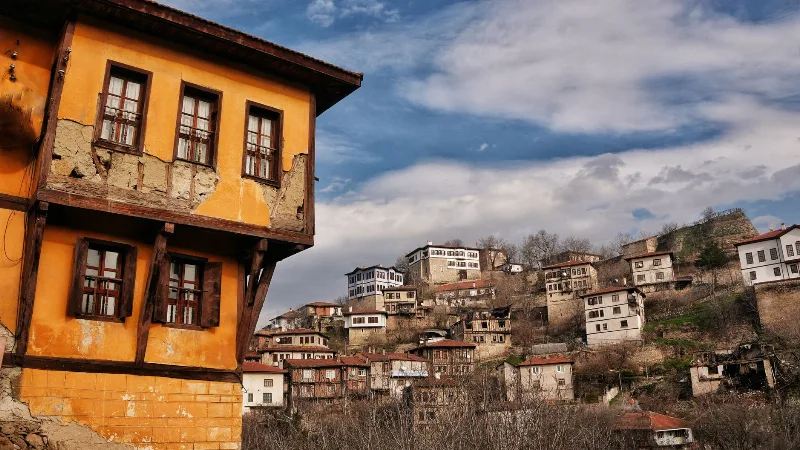
The defining feature of Beypazarı is its housing stock. The classic house here has a stone ground floor, a timber-framed upper floor finished in white plaster, and a projecting bay carried on wooden brackets so that the upper rooms overhang the lane. Roofs are pitched and covered in tile, courtyards are usually walled and inward-facing, and the streets between the houses are narrow, sometimes stepped, and follow the contour of the slope rather than any grid. Many of the houses have been repaired over the past few decades and are lived in; others stand empty or partly collapsed, which gives the old neighbourhood a mixed, working texture rather than a uniformly restored appearance.
Crafts, mineral water and the carrot harvest
Beypazarı's reputation rests on three things beyond its architecture. The first is mineral water: springs in and around the town have been bottled for decades, and the water is part of the town's identity in a way that is unusual for an inland Anatolian settlement. The second is craft work, particularly silver filigree, copper beating and the hand-printed cotton headscarves known locally as yazma, which were traditionally produced for the town's own market and the surrounding villages. The third is agriculture. The valley is a major carrot-growing area, and in late summer and autumn the fields and the roadsides at the edge of town are occupied by the harvest; the town is also known for a hard, long-keeping dry biscuit sold and eaten locally.
Walking the streets
The historic core is compact enough to cover on foot in an afternoon, though the gradients mean the walk is more tiring than the distances suggest. A natural route starts in the lower commercial centre, climbs into the residential lanes behind it, and continues up to Hıdırlık Tepesi, the hill that overlooks the town. From the top the whole layout becomes legible: the dense band of tiled roofs along the valley, the flat cultivated floor beyond, and the bare ridges on either side. On the way up and down you pass mosques from different periods, a late Ottoman stone school building, fountains and a number of houses that have been converted into small museums, including a town history and culture museum with ethnographic collections and period rooms.
Religious and civic buildings
Among the town's older monuments, the Sultan Alaeddin Mosque is generally attributed to the 13th-century Seljuk period and retains a plain, heavy stone character quite different from the later Ottoman mosques in the centre. Other mosque and mosque-complex buildings date from the Ottoman centuries, when Beypazarı was a sizeable provincial market town on the roads running west from Ankara. These buildings are working places of worship rather than visitor attractions, and the most useful way to see them is simply to walk past during the day and note the contrast between Seljuk stonework, Ottoman masonry and the timber-and-plaster domestic architecture around them.
İnözü Vadisi and the surrounding landscape
A short distance from the centre, the İnözü valley cuts into the plateau as a narrow limestone gorge. Its sides hold rock-cut chambers, stairs and passages, and small cave churches with painted interiors that are usually associated with the Byzantine period, though the site has never been fully explained. Walking into the gorge is the main outdoor activity around Beypazarı: the route follows the stream bed, the rock walls close in, and the temperature drops noticeably in summer. Sturdy shoes are advisable, as the ground is uneven and can be slippery, and the paths are not adapted for wheelchair access. Beyond the gorge, the countryside opens into the cultivated valley and low hills used for grain, vines and fruit.
A brief history
The site has a long recorded history. In the Roman and Byzantine periods the settlement appears in ecclesiastical records under the names Lagania and Anastasiopolis, and it remained a minor bishopric and staging point rather than a large city. After the arrival of the Seljuks and then the Ottomans, it developed as a market town serving the rural districts between Ankara and the forests to the north-west, which is the role reflected in its name. The 20th century brought gradual depopulation of the old quarter as families moved to newer housing and to Ankara, and from the 1990s onwards a sustained restoration effort brought many of the houses back into use. That combination of decline, survival and piecemeal repair is what gives the town its present character.
Getting there and moving around
Beypazarı is reached by road, normally via Ayaş; the drive from central Ankara takes roughly an hour and a half, and coach services connect the town with the capital. Once in the town, a car is more of a burden than a help: the historic streets are narrow and steep, parking is limited in the old quarter, and the main sights are within walking distance of each other. A vehicle is useful only for reaching the İnözü gorge, nearby villages and the wider district, where public transport is sparse. The town is a realistic day trip from Ankara, but staying overnight allows an early or late walk through the streets when the centre is quiet.
When to visit
Spring, from April to June, is the most comfortable period: the hills are still green, the valley is irrigated and planted, and daytime temperatures are moderate. September and October are equally good, with the carrot harvest under way and cooler walking conditions. July and August are hot and very dry, and the exposed slopes above the town offer little shade. Winter is cold, often snowy, and the steep lanes can become difficult; it is also the quietest season, when the town reverts entirely to its own routines. A weekly market fills the centre on its market day, and that is when the town is busiest with people from the surrounding villages.
Practical notes before you go
Beypazarı is a real working town, not a staged heritage site, so expectations should be set accordingly: some streets are uneven, some houses are ruinous, and the old quarter is quieter than the busy modern centre below it. The hillside walks, especially the climb to Hıdırlık Tepesi and the paths in the İnözü gorge, require reasonable mobility and suitable footwear. Public facilities in the historic core are limited, and it is sensible to carry water in summer. Turkish is the everyday language; English is understood in some places but not universally. The town's drinking and mineral water is a local point of pride, and the dry biscuit and carrots are the things people from Ankara most often take home.
Places near Beypazarı
Several settlements in the same part of Ankara Province make a natural extension to a visit. Ayaş, on the road back towards the capital, is a small historic town with its own old houses and thermal springs. Güdül, further east, sits in a valley with rock formations and traditional houses. To the north-west, Nallıhan is known for its bird sanctuary on the reservoir and for its hand-embroidered silk work. The Kirmir valley and the hills between these towns are themselves worth driving through slowly, since the landscape of dry ridges cut by green watercourses is what defines this corner of Central Anatolia.
From the land
Find All →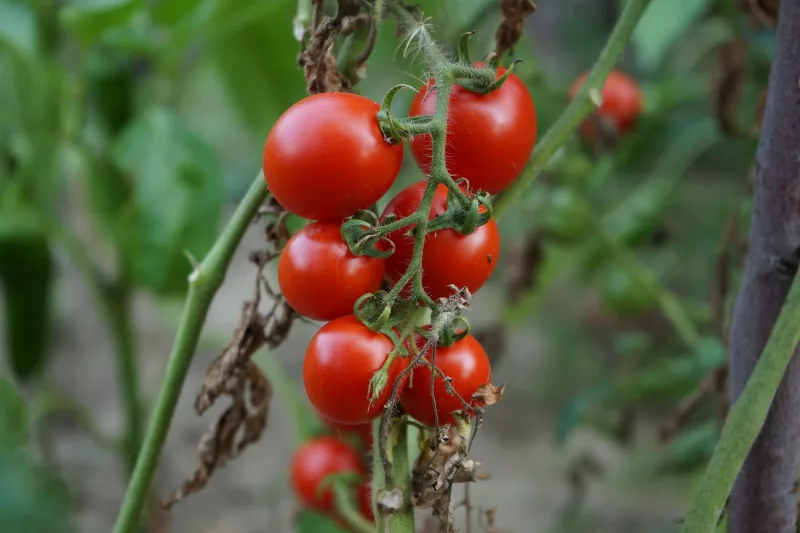
Antalya Tomatoes
Antalya tomatoes are the greenhouse and field-grown tomatoes of Türkiye's Mediterranean coast, produced in a province whose mild winters and long sunny summers allow harvesting in almost every month of the year.
Explore →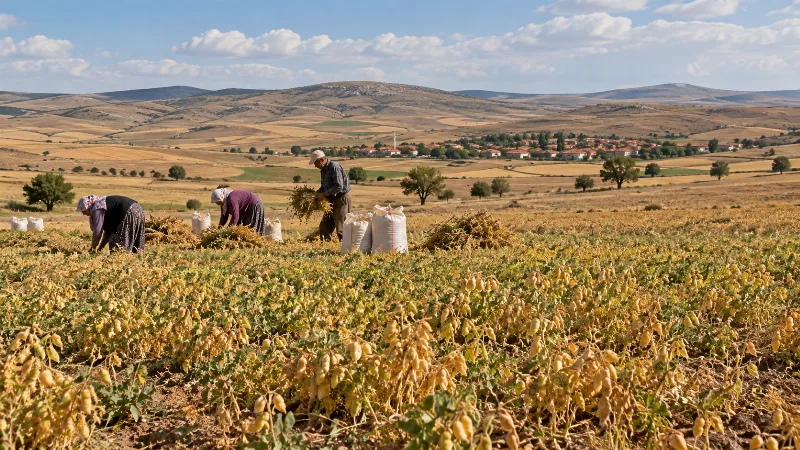
Yozgat Lentils
Yozgat lentils are the green lentils grown on the high interior plateau of Yozgat province in Central Anatolia, where cold winters, dry summers and thin, well-drained soils suit a drought-tolerant legume better than most crops.
Explore →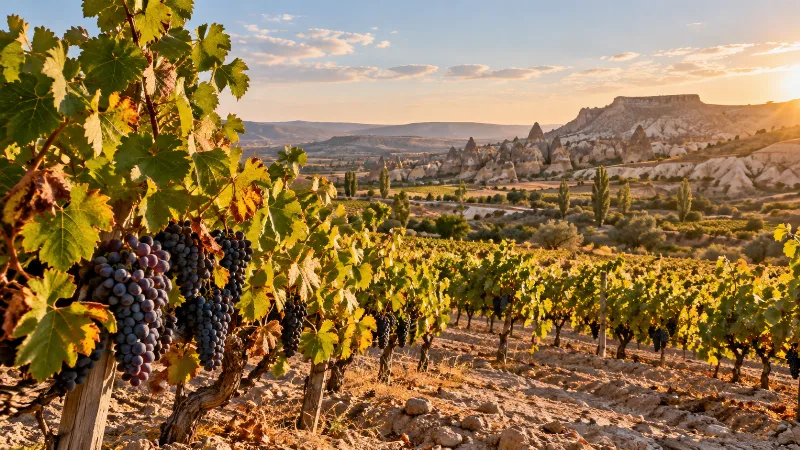
Nevşehir Grapes
Nevşehir grapes come from the volcanic plateau of Cappadocia in central Türkiye, where thin tuff soils, high elevation and dry summers support vineyards grown for wine, grape molasses and drying.
Explore →Related content
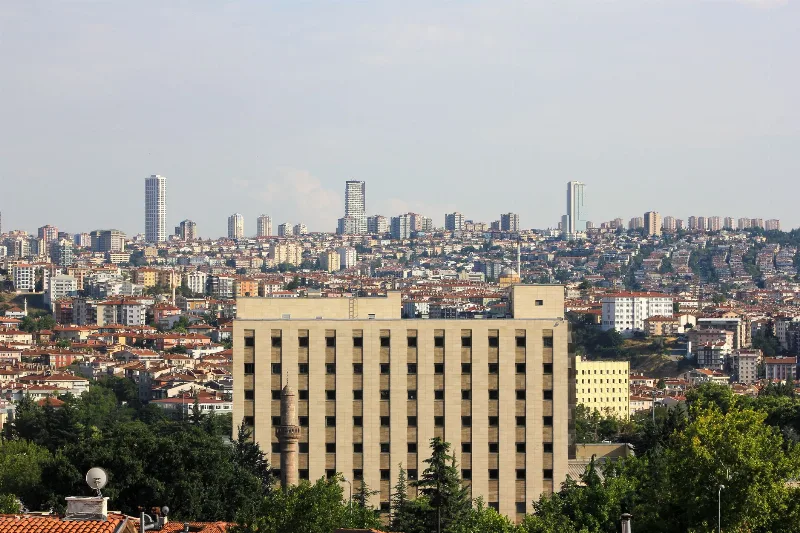
Ankara
Ankara is the capital of Türkiye and the country's second-largest city, set on the high plateau of Central Anatolia and defined by its republican institutions, its long pre-Ottoman history and the mausoleum of Mustafa Kemal Atatürk.
Beypazarı Traditional Houses and Silver Work in Ankara
Beypazarı, a district town in Ankara Province, is known for its well-preserved Ottoman-era houses and a silver-working tradition that still fills its old market streets.

Beypazarı Carrots
Beypazarı carrots are the sweet, crisp orange carrots grown in the stream-fed valley of Beypazarı, a district of Ankara Province in Central Anatolia. Deep alluvial soils, irrigation water and a long vegetable-growing tradition have tied the district's name to this single root crop.

Konya Carrots
Konya carrots are grown on the irrigated plains of central Türkiye, where deep alluvial soils and a continental climate produce firm, sweet and crunchy roots.
Traditional Villages of Türkiye
Türkiye's traditional villages blend stone houses, timber balconies and seasonal customs into landscapes that reveal the country's rural heritage.

Cities in Türkiye
Discover Türkiye's vibrant cities, each offering unique traditions and sights, making them captivating travel destinations.