
Termessos
Termessos is an abandoned Pisidian city on a mountain plateau inside Güllük Mountain National Park, northwest of Antalya, known for its theatre, temples and rock-cut tombs. Reaching the ruins requires a steep walk.
Termessos is an ancient Pisidian city built on a natural plateau on the slopes of Güllük Mountain, roughly 30 kilometres northwest of Antalya in southern Türkiye. The site sits inside Güllük Mountain National Park, a protected area of cedar forest and limestone peaks established in 1970, and it is one of the most intact ancient mountain settlements in the country. Its ruins, including defence walls, a theatre, temples, an odeon, cisterns and a large necropolis, survive largely because the city was abandoned rather than built over, and because much of it has never been systematically excavated.
A City Shaped by the Pisidian Mountains
Termessos belonged to Pisidia, the rugged inland region of the western Taurus Mountains, rather than to the coastal world of Lycia and Pamphylia to the south. The ancient name of the mountain above the city was Solymos, and the city's principal deity, Zeus Solymeus, took his title from it. That pairing of a mountain cult with a defensible high position is characteristic of Pisidian settlement, but Termessos is the best-preserved example of it.
The plateau lies at roughly 1,000 metres and commands the approach to a pass that links the Antalya plain with the interior towards Korkuteli. Cliffs and steep slopes protect it on several sides, and the city walls follow the natural line of the rock. The result is a settlement that was difficult to reach, difficult to attack and clearly chosen for control of movement between the coast and the highlands.
The City Alexander the Great Chose Not to Attack
Termessos is best known historically for surviving Alexander the Great. In 333 BC, on his march along the southern coast, Alexander found the Termessians holding the pass and did not attempt to take the city, continuing eastwards instead. The episode became a standard part of the city's later self-image: Termessos presented itself as a community that had never been conquered.
That independence was not simply a matter of terrain. Termessos negotiated its position carefully in the Hellenistic and Roman periods, and inscriptions record that it secured a privileged relationship with Rome as a friend and ally of the Roman people. This status allowed the city to keep its own institutions and laws while neighbouring communities were absorbed into the provincial system. It minted its own coinage and continued to use its own Pisidian identity long after much of the surrounding region had adopted Greek language and customs.
The end of the city is less clearly documented than its survival. Termessos was gradually abandoned, and among the explanations usually discussed are earthquake damage and the failure of the water system that supplied the plateau. There is no dramatic destruction layer here, only a slow emptying of the streets.
What Stands on the Plateau Today
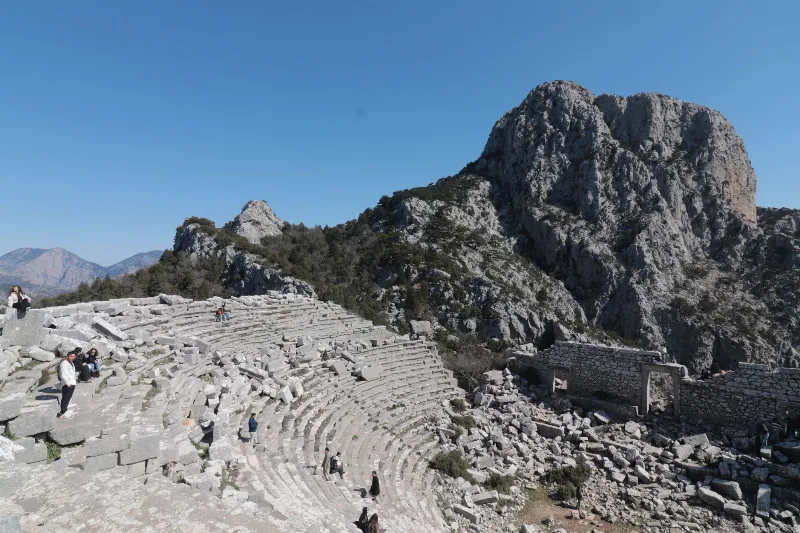
Visitors arriving at the ruins first pass through the fortifications and the lower city before reaching the main group of monuments on the saddle. The theatre is the most immediately recognisable structure, set against the slope with its cavea cut into the rock and its seating facing out over the drop towards the coastal plain. It is a Hellenistic theatre later adapted in Roman times, and it remains legible enough to understand how the audience entered and how the stage building closed the view behind the performance area.
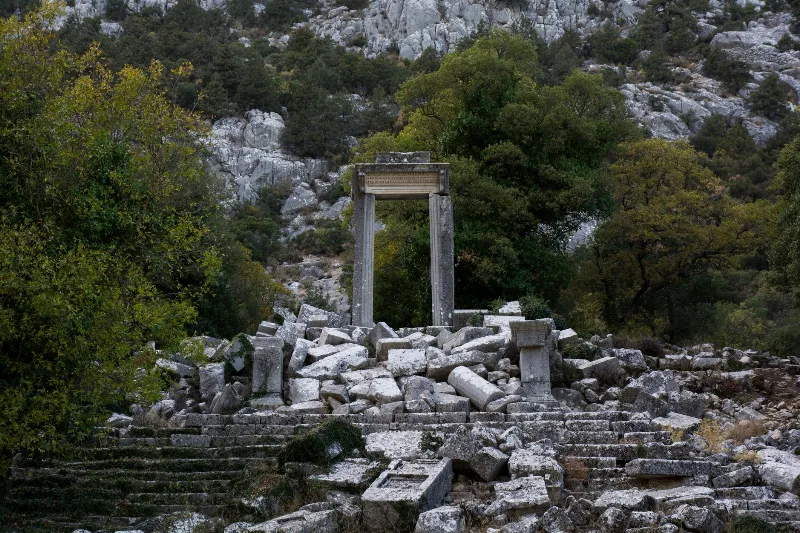
Close to the theatre and the upper agora are the odeon, a small roofed hall used for meetings and performances, and the remains of a colonnaded street and stoas that once framed the civic centre. Further along the plateau are the foundations of a gymnasium and a bath complex, along with the platforms of temples, including those associated with Artemis and with Zeus Solymeus. Dozens of rock-cut cisterns are scattered across the site, a reminder that every drop of water on this dry plateau had to be captured and stored.
The sense of a functioning city is stronger here than at many better-known archaeological sites, because the street plan, the drainage channels and the relationship between public buildings and residential terraces are still visible in the bedrock.
The Necropolis and the Heroon of Alcetas
The necropolis spreads across the slopes outside the walls and is one of the largest in the region. It contains sarcophagi, rock-cut chamber tombs and family plots, many of them still in their original positions along the tracks.
The most famous single monument is the heroon of Alcetas, a Macedonian commander and brother of Perdiccas who took refuge in Termessos after his cause collapsed in the wars that followed Alexander's death. According to the ancient accounts, the Termessians debated handing him over, and Alcetas took his own life rather than be surrendered. The young men of the city honoured him with a tomb, and the reliefs on the structure are connected with that story. His remains were later returned to Macedonia. The building is small, but it gives the necropolis a specific historical anchor rather than a general atmosphere of antiquity.
Landscape, Forest and Wildlife
Güllük Mountain National Park protects more than the ruins. The plateau and the surrounding slopes are covered with cedar forest, including stands of cedar of Lebanon, mixed with pine and maquis. The park is also known for its flora, with a number of plant species found only in this part of the Taurus, and for wildlife such as mountain goats and birds of prey that use the cliffs. The combination of archaeological remains and unmanaged forest is what makes the site feel remote even though Antalya is visible in the distance.
Getting There and the Walk Up
Termessos lies around 30 kilometres from central Antalya, reached by the road towards Korkuteli and then a signed turning into the national park. Public transport does not serve the site directly, so most visitors arrive by car or on an organised excursion, and the final section of road climbs through forest to a car park below the ruins.
From the car park, a steep and rocky path climbs to the main monuments. The walk usually takes between 20 and 30 minutes one way, but the surface is uneven, with loose stones and steps cut into the rock, and there is very little shade. Sturdy shoes are essential, and the descent is harder on the knees than the climb. A rougher track serves the upper part of the site, but the standard visit involves walking. Inside the ruins, paths link the theatre, the agora and the necropolis, and the terrain remains rough throughout, with drops beside some of the walls. Facilities at the site are minimal, so water and sun protection should be brought from Antalya.
Weather and the Best Time to Visit
Spring, from roughly April to early June, and autumn, from September to November, are the most comfortable periods. Daytime temperatures are moderate and the forest and wildflowers are at their best in spring. Summer is genuinely hot, and the exposed limestone of the plateau radiates heat, so an early start is important. Winter brings rain, and snow occasionally falls at this elevation, which can make the path slippery and the rock steps hazardous. Morning visits also avoid the haze that builds over the coastal plain and obscures the view from the theatre.
Practical Points Before You Set Out
- Allow at least three to four hours for the round trip, including the climb and time among the ruins.
- Carry more water than you think you need; there are no reliable drinking sources on the plateau.
- Wear shoes with good grip, since much of the walking is on bare rock and loose scree.
- Stay on the marked routes; some tombs and cisterns are open shafts in the ground.
- Do not remove or move anything from the site, and keep to surfaces rather than climbing on fragile masonry.
- Mobile coverage can be patchy in the forested sections of the park.
Places to Combine with a Visit
The natural pairing is with Antalya itself, where the old harbour district and the Antalya Museum, which holds material from the region's ancient cities, give useful context. Karain Cave, a prehistoric site in the same limestone massif north-west of the city, lies on a similar route and is often visited on the same day. Further afield along the coast are the Roman theatres and city ruins of Perge, Aspendos and Phaselis, and inland the canyon country around Yazılı Kanyon offers a different kind of Taurus landscape. All of these sit within reach of Antalya and work well alongside Termessos for anyone interested in the archaeology of Pisidia, Lycia and Pamphylia.
Related content
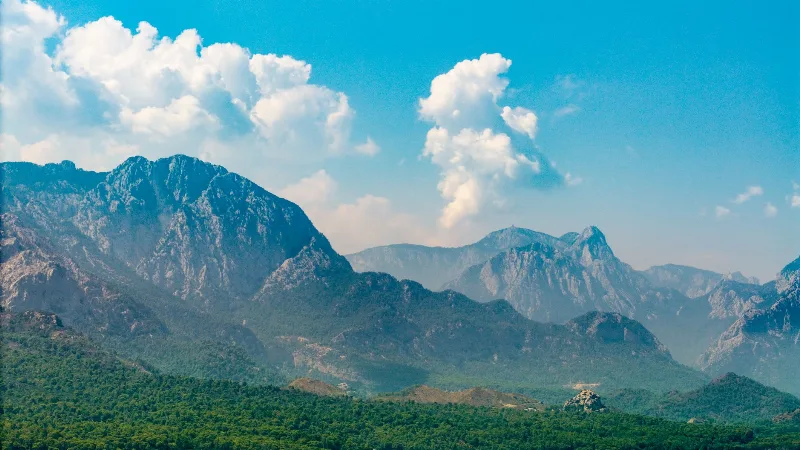
Antalya
Antalya offers a unique blend of vibrant history and stunning natural beauty, making it a must-visit destination in Türkiye.
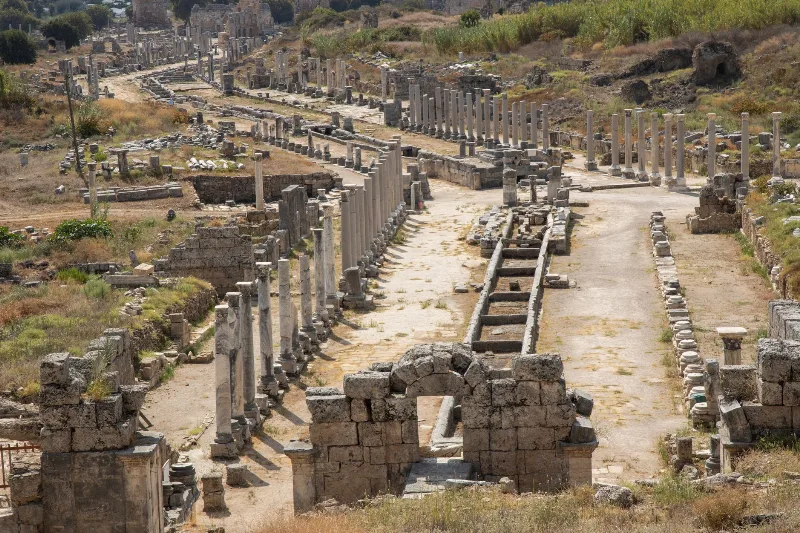
Perge
Perge is a Graeco-Roman city in the Pamphylian plain east of Antalya, Türkiye, whose surviving urban plan includes two colonnaded streets with central water channels, a hillside Roman theatre and one of Anatolia's best-preserved stadiums.
Perge
Perge is an ancient Pamphylian city east of Antalya, whose Hellenistic gates, colonnaded streets, theatre and exceptionally well-preserved stadium make it one of the most legible Roman-era sites in southern Turkey.
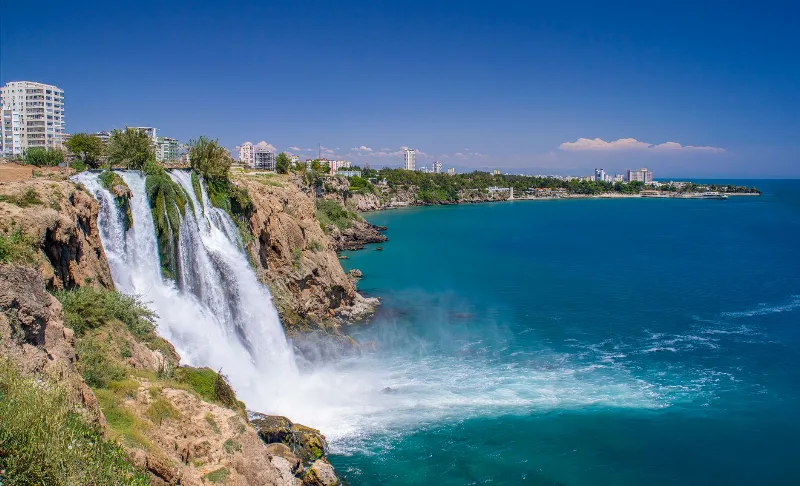
2-Day Antalya Waterfalls and Ancient Cities Route
A circular two-day route based in Antalya that pairs the Düden and Kurşunlu waterfalls with the ancient cities of Perge, Aspendos and Termessos, following the eastern coastal plain on the first day and the Taurus foothills on the second.
Antalya's Ancient Ruins
Antalya's ancient ruins trace Lycian, Pamphylian, Roman and Byzantine life across the Mediterranean coast and the Taurus foothills. Scattered theatres, colonnaded streets and rock-cut tombs reveal how successive peoples shaped this landscape.
Termessos: The Pisidian Mountain City of Antalya
Termessos is an ancient Pisidian city set high in the Taurus Mountains of Antalya Province, Türkiye. Its abandoned ruins, including a theatre, gymnasium, cisterns and a sprawling necropolis, form one of the most complete archaeological landscapes of the Pisidian region.