
Yazılıkaya
Yazılıkaya is an open-air Hittite rock sanctuary cut into limestone near the ancient capital of Hattusa, decorated with reliefs of gods and kings and now part of a UNESCO World Heritage Site.
Yazılıkaya, whose Turkish name means inscribed rock, is an open-air Hittite sanctuary carved into a limestone outcrop about two kilometres northeast of Hattusa, the capital of the Hittite Empire. It lies close to the village of Boğazkale in Çorum Province, in the central Anatolian highlands of Türkiye. Rather than a roofed temple or a settlement, the site consists of two roofless chambers cut into natural bedrock and lined with reliefs of deities, kings and symbolic figures. It is widely interpreted as a cult place tied to Hittite festivals, and since 1986 it has formed part of the UNESCO World Heritage listing for Hattusa, the Hittite capital.
A Sanctuary Cut Into Living Rock
Yazılıkaya is not a building in the conventional sense. The Hittites made use of a natural rocky outcrop with a distinctive fissure, then shaped and smoothed the vertical faces to create flat panels for carving. This approach is one of the reasons the place feels different from the excavated mud-brick and stone architecture of Hattusa itself: the reliefs sit directly on the living rock, in the open air, exposed to sun, rain and wind for more than three thousand years.
The sanctuary is divided into two connected spaces, usually called Chamber A and Chamber B. Chamber A is by far the larger of the two, a broad open court with high rock walls. Chamber B is a narrower passage reached through a gap in the rock, and it has a more enclosed, private character. Between them the two chambers hold dozens of carved figures, making Yazılıkaya one of the most concentrated collections of Hittite relief sculpture anywhere in Anatolia.
Chamber A: The Assembly of the Gods
The main chamber is dominated by two long processions of deities that converge on a central panel. On one side, male gods advance in a line; on the other, female deities move to meet them. The leading figures of each group are the most prominent: the Storm God and the Sun Goddess, the two deities at the head of the Hittite pantheon. Many of the figures can be identified because short inscriptions in Luwian hieroglyphs were carved beside them, and their attributes — weapons, animals, mountains, and symbols of power — help distinguish one deity from another.
The central scene is often described as a meeting between the leading god and goddess, with smaller figures arranged around them. Elsewhere in the chamber, panels depict kings of the Hittite New Kingdom, including Tudhaliya IV, presented in the company of gods. The scale and repetition of the reliefs suggest that Chamber A functioned as a stage for the whole divine order as the Hittites understood it, rather than as a gallery of individual portraits.
Chamber B: The Underworld and the Royal Image
Chamber B is reached through a narrow opening and is smaller and more dimly lit. Its most striking feature is a relief of a sword-shaped deity, a figure whose blade-like body is topped by a human head. This image is generally associated with the underworld and with the darker, chthonic side of Hittite religion.
The chamber also contains a row of twelve figures, frequently described as the gods of the underworld, shown in a compact, repeating procession. On one wall is a well-known relief of King Tudhaliya IV standing within the protective embrace of a deity, a composition that underlines the close relationship the Hittite kings claimed with the gods. Because of its scale, its underworld imagery and its royal focus, Chamber B is sometimes interpreted as a place connected with the commemoration of a king, though its exact function continues to be discussed by scholars.
Ritual Purpose and the Hittite Festival Calendar
Yazılıkaya is most often linked to the purulli festival, a major Hittite celebration associated with the New Year and the arrival of spring. Hittite texts describe festivals in which the king, the royal family and priests moved between Hattusa and nearby sacred places, and the layout of Yazılıkaya — an open court where a large group of deities is assembled — fits this kind of ceremonial use. The reliefs would have formed a permanent backdrop for rituals that were otherwise performed with temporary installations, offerings and processions.
It is important to note that no roof, altar or statue base survives in a form that would prove exactly how ceremonies were conducted here. What the sanctuary does show clearly is that the Hittites treated the natural landscape itself as a sacred setting, and that they used carved stone to make the divine world permanently present in one place.
Historical Study and World Heritage Status
The reliefs at Yazılıkaya were noted by nineteenth-century European travellers and researchers, and the site became part of the wider rediscovery of the Hittites as a major ancient civilisation. Later, long-term archaeological work at Hattusa and its surroundings, carried out by the German Archaeological Institute, produced detailed documentation of the sanctuary and helped connect its figures to the Hittite pantheon known from cuneiform tablets found in the city.
Yazılıkaya does not have its own separate UNESCO listing. It is protected as part of the World Heritage Site inscribed for Hattusa, which recognises the former Hittite capital together with its associated sacred places. That status reflects both the archaeological value of the rock carvings and the way the sanctuary complements the urban remains in the valley below.
Visiting Yazılıkaya: Access and Terrain
The sanctuary lies a short distance from the main ruins of Hattusa, and most visitors combine the two in a single trip. Access is normally by road. Boğazkale, the nearest village, sits right beside the Hattusa archaeological area and has basic services; the larger city of Çorum is roughly 85 kilometres to the north, and Ankara is around 200 kilometres to the west. Public transport to the immediate site is limited, so arriving by private car, taxi or an organised excursion is the usual approach.
Once at the site, expect uneven, stony ground and short uphill sections between the entrance and the chambers. The reliefs are viewed from pathways, and some panels sit close to the ground while others are high on the rock face, so a little walking and looking upward is part of the visit. The chambers are open to the sky, with no shelter, and the surfaces are natural rock rather than polished museum floors. Visitors with limited mobility should check current on-site conditions in advance, since the terrain is not uniformly flat.
Seasons, Light and Comfort
The central Anatolian plateau has a continental climate. Summers are hot and dry, with strong midday sun and little shade at the sanctuary, while winters are cold and can bring snow and ice that make paths slippery. The most comfortable periods are generally spring, from about April to early June, and early autumn, in September and October, when temperatures are moderate.
Light matters a great deal at Yazılıkaya. Low sun in the morning or late afternoon tends to pick out the carved surfaces more clearly than harsh overhead light, when the reliefs can look flat. Rain and snow can obscure details, and wet rock may limit access to certain parts of the site. Planning a visit for a clear day and allowing enough time to look slowly is more rewarding than a quick stop.
Nearby Places Worth Combining With a Visit
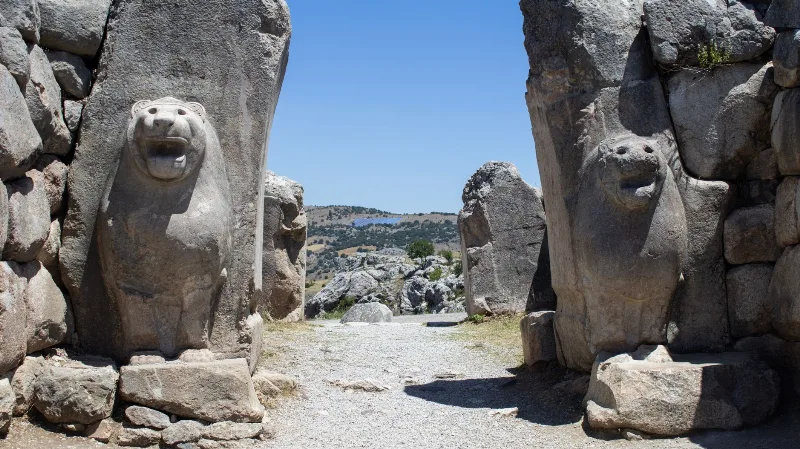
Because Yazılıkaya is closely tied to Hattusa, the most natural addition to any visit is the capital itself. The Hattusa ruins include the Great Temple, the Lion Gate, the King's Gate and long stretches of the city wall, and they give context to the sanctuary by showing the urban and administrative world that supported it. The small museum in Boğazkale displays finds from the area and helps explain the objects and inscriptions recovered from the site.
Further north, Alacahöyük is another important prehistoric and Hittite site with its own monumental gate and royal tombs, and it can be combined with a broader loop through Çorum Province. The city of Çorum offers a base with museums and accommodation, while travellers heading east or north may also consider Amasya, known for its rock-cut tombs and Ottoman architecture, as part of a wider Anatolian itinerary.
What to Keep in Mind Before You Go
Yazılıkaya rewards a little preparation. Understanding that the reliefs represent a divine assembly, that the two chambers served different purposes, and that the site is a religious space rather than a palace will make the carvings far more legible. Bring water and sun protection in warm months, wear shoes suitable for rough ground, and allow time to study the panels rather than passing through quickly. The sanctuary is small in area but dense in meaning, and its value lies as much in what it reveals about Hittite beliefs as in the visual impact of the carvings themselves.
Related content
Hattusa
Hattusa was the capital of the Hittite Empire, located near Boğazkale in Çorum Province. Its surviving walls, gates, temples and cuneiform archives make it one of the most important Bronze Age archaeological sites in Anatolia.
Ankara
Ankara is the capital of Türkiye and the country's second-largest city, set on the high plateau of Central Anatolia and defined by its republican institutions, its long pre-Ottoman history and the mausoleum of Mustafa Kemal Atatürk.
Alacahöyük
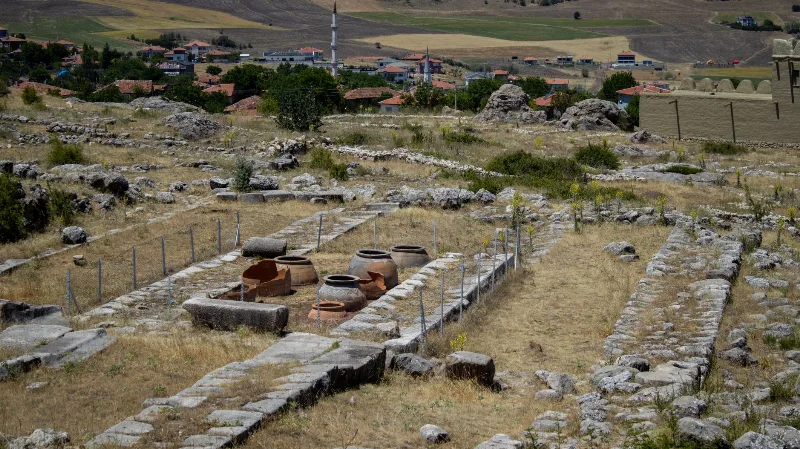
In Çorum Province, Alacahöyük preserves a long settlement sequence, elite Early Bronze Age burials and a monumental Hittite gate with carved reliefs.
Hattusa: The Hittite Capital at Boğazkale, Çorum
Hattusa was the seat of the Hittite Empire in the Late Bronze Age and is now a UNESCO World Heritage Site in Çorum Province, Türkiye. Its walls, temples, gates and the nearby rock sanctuary of Yazılıkaya make it one of the most important archaeological landscapes in the ancient Near East.
The Ancient Hittite Capital of Hattusa
Hattusa, the Hittite capital in Çorum, preserves monumental gates, temples and royal buildings from one of the ancient Near East's great powers.
Alacahöyük: A Hittite City and Early Bronze Age Royal Tombs in Çorum
Alacahöyük is an excavated mound in Çorum Province that holds both Early Bronze Age royal tombs and a monumental Hittite gate flanked by carved sphinxes. It is one of the key sites for reading the pre-Hittite and Hittite past of central Anatolia.